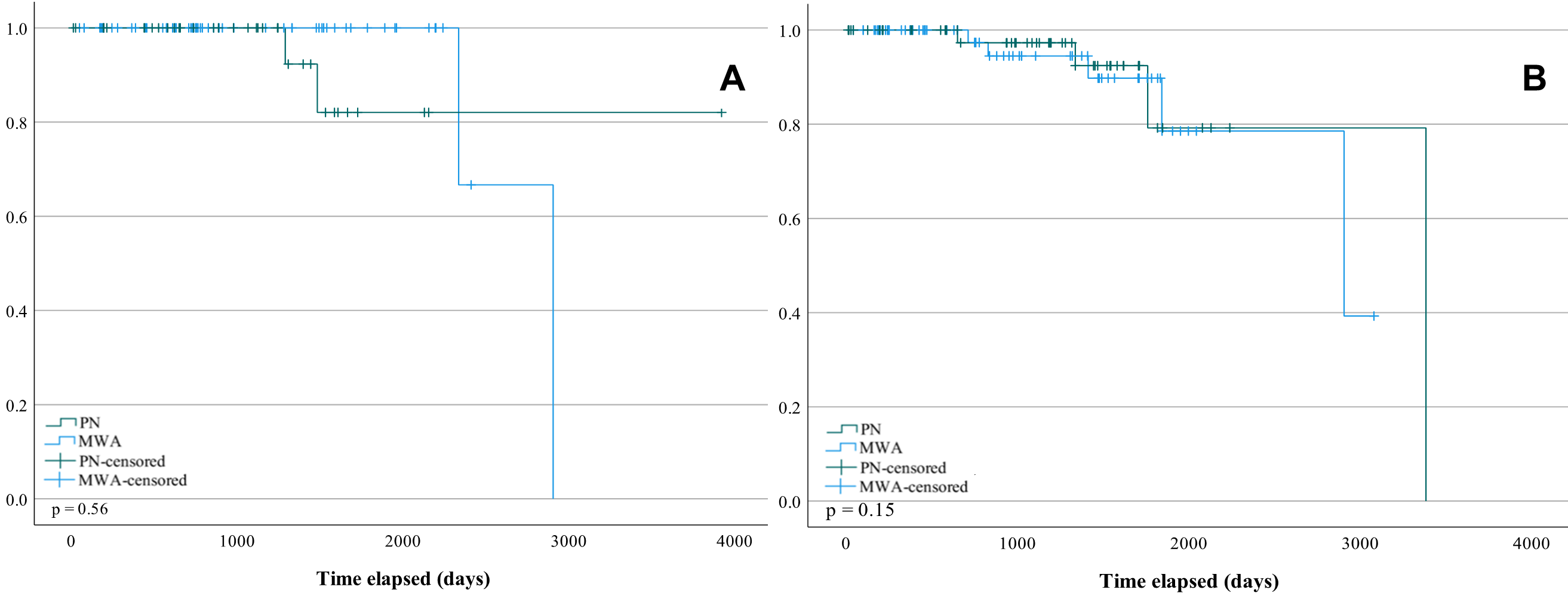
Introduction: Thermal ablation (TA) is a widely accepted approach for T1a renal masses < 3 cm in size, with a gap in research of masses sized 3-4 cm. While much literature focuses on radiofrequency ablation (RFA) as the primary TA modality, a growing body of literature is showing the safety and efficacy of microwave ablation (MWA). In this study we aim to compare the oncological and renal function outcomes of MWA compared to partial nephrectomy (PN) in two small renal mass (SRM) tumor size groups, < 3 cm and 3-4 cm. Methods: This study included retrospective data from 2009-2015 and prospective data since 2015 from a single-institution database. Patient demographics, renal mass characteristics, and treatment outcomes were collected. Survival curves and hazard analysis were used to assess oncological outcomes. Changes in eGFR and CKD stage following surgery were used to assess renal function outcomes. Results: A total of 91 PN and 130 MWA patients matched the inclusion criteria. For both tumor sizes, median age and Charlson Comorbidity Index (CCI) of MWA patients were greater than PN, while median length of stay was shorter . No difference in local recurrence free survival was found between treatment modalities on survival analysis for masses < 3 cm (p=0.56) and sized 3-4 cm (p=0.15). No difference in local recurrence free survival was found between treatment modalities on hazard analysis for masses < 3 cm (p=0.56) and sized 3-4 cm (p=0.70). Pre-operative renal function was significantly lower in patients undergoing MWA for both tumor sizes, however there was no significant difference in the post-operative change in renal function between MWA and PN for tumors up to 4 cm. Conclusions: While MWA patients are older and have more comorbidities, oncological outcomes and renal preservation were comparable between MWA and PN for SRMs < 3 cm and 3-4 cm. Our findings suggest that MWA can be used as a safe and effective alternative to PN for SRM tumors up to 4 cm. SOURCE OF Funding: None.