Session: MP47: Kidney Cancer: Localized: Surgical Therapy II
MP47-20: Prognostic factors for recurrence after robot-assisted laparoscopic partial nephrectomy: Real-world data from Japanese single high-volume center
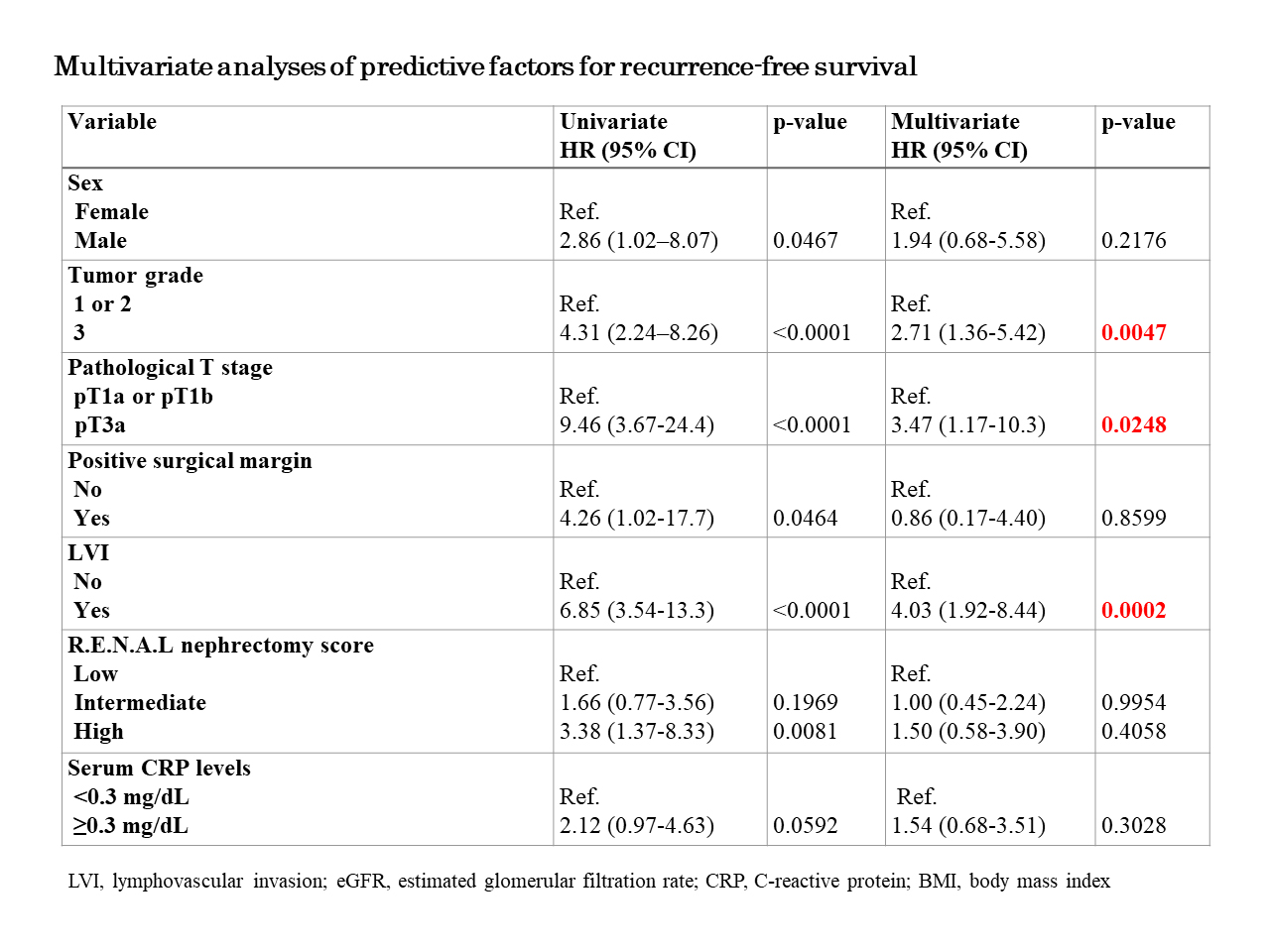
Introduction: Robot-assisted partial nephrectomy has been accepted as a standard treatment option for small renal cell carcinoma. For careful follow-up after surgery, identifying prognostic factors for recurrence is important. However, few studies have investigated the recurrence of renal cell carcinoma after partial nephrectomy, focusing on robotic surgery. Therefore, we investigated post-operative recurrence-free survival and predictive factors that affect tumor recurrence after robot-assisted partial nephrectomy. Methods: In total, 1039 patients who underwent robot-assisted laparoscopic partial nephrectomy for clinical T1 renal cell carcinoma at a single institution between January 2013 and December 2020 were retrospectively evaluated. Results: The median age was 59 years and the median tumor size was 30 mm. With a median follow-up of 37 months (Interquartile range 24-53 months), 38 patients (3.7%), including 6 with local recurrence, 5 recurrence in the operated kidney, and 27 with other organs or lymph-nude, experienced recurrence. The 3-year recurrence-free survival was 97%. Multivariate analyses revealed high grade tumor (hazard ratio: 2.71, p = 0.0047), upstaging to pathological T3a (hazard ratio: 3.47, p = 0.0248) and lymphovascular invasion (hazard ratio: 4.03, p = 0.0002) were independent prognostic factors for worse recurrence-free survival (Table). Conclusions: In conclusions, patients after robot-assisted laparoscopic partial nephrectomy with high grade tumor, upstaging to pathological T3a and lymphovascular invasion had a risk of worse recurrence-free survival. SOURCE OF Funding: None.