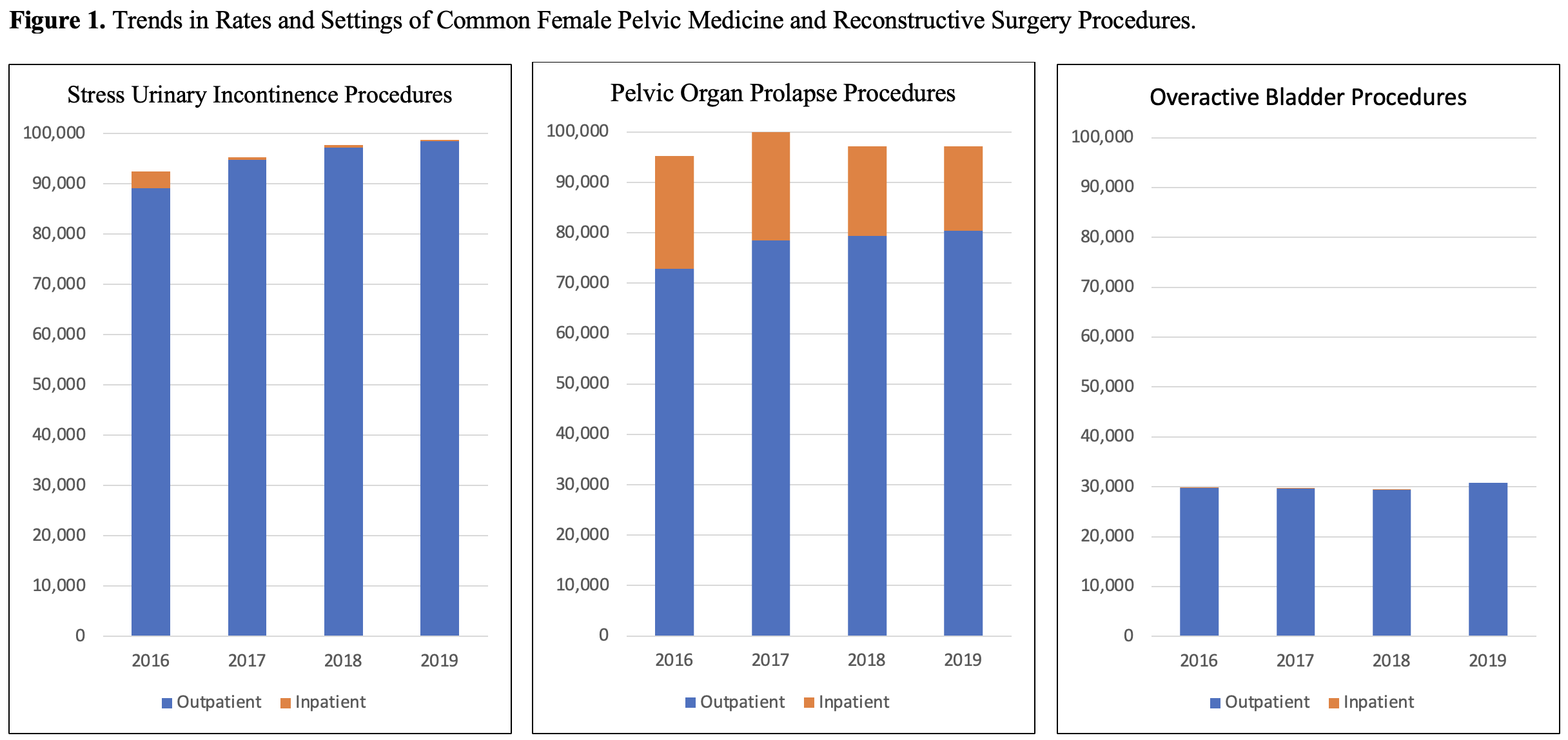
Introduction: To evaluate national trends in settings and charges of common female pelvic medicine and reconstructive surgery (FPMRS) procedures. Methods: Common FPMRS procedures were identified by Current Procedural Terminology and International Classification of Diseases (10th Revision) Procedure Coding System codes and classified into 3 categories: 1) stress urinary incontinence procedures (SUI-p) 2) pelvic organ prolapse procedures (POP-p) and 3) overactive bladder procedures (OAB-p). Data from inpatient (IP) and outpatient (OP) encounters for included procedures between 2016-2019 were extracted from the Nationwide Inpatient Sample and Nationwide Ambulatory Surgery Sample from the Healthcare Cost and Utilization Project. Stratified cluster sampling was used to create weighted, national estimates. Student t-tests and multivariable linear regression was performed to compare procedural factors. Results: A total of 893,450 weighted procedures were analyzed, of which 9.3% were performed IP and 90.7% were performed OP. Over the study period, there was a 4.3% increase in total number of procedures, and the proportion performed OP increased from 88.1% to 92.5%. Between 2016-2019, there was a 10.6% and 10.5% increase in SUI-p and POP-p performed OP, respectively. Over the study period, proportion of SUI-p performed OP increased from 96.4% to 99.7%, and proportion of POP-p performed OP increased from 76.5% to 82.8%. 99.9% of OAB-p were performed OP. Charges for SUI-p performed IP were $16,705 higher than those performed OP (p = 0.007) and charges for POP-p performed IP were $21,864 higher than those performed OP (p < 0.0001). Predictors of SUI-p and POP-p being performed OP included private insurance, fewer co-morbidities, and receiving care at a rural facility or at a center in the Midwest or South. Additionally, SUI-p were more likely to be performed OP for patients < 52 years of age. POP-p were more likely to be performed IP than SUI-p (OR 20.8; 95% CI 20.2 - 21.5), while OAB-p were less likely to be performed IP than SUI-p (OR 0.01; 95% CI 0.01 – 0.02). Conclusions: An increasing majority of SUI and OAB procedures performed nationwide are performed in OP settings. These procedures performed OP carry less charge than those performed IP and are more likely for younger, healthier patients with private insurance SOURCE OF Funding: N/A