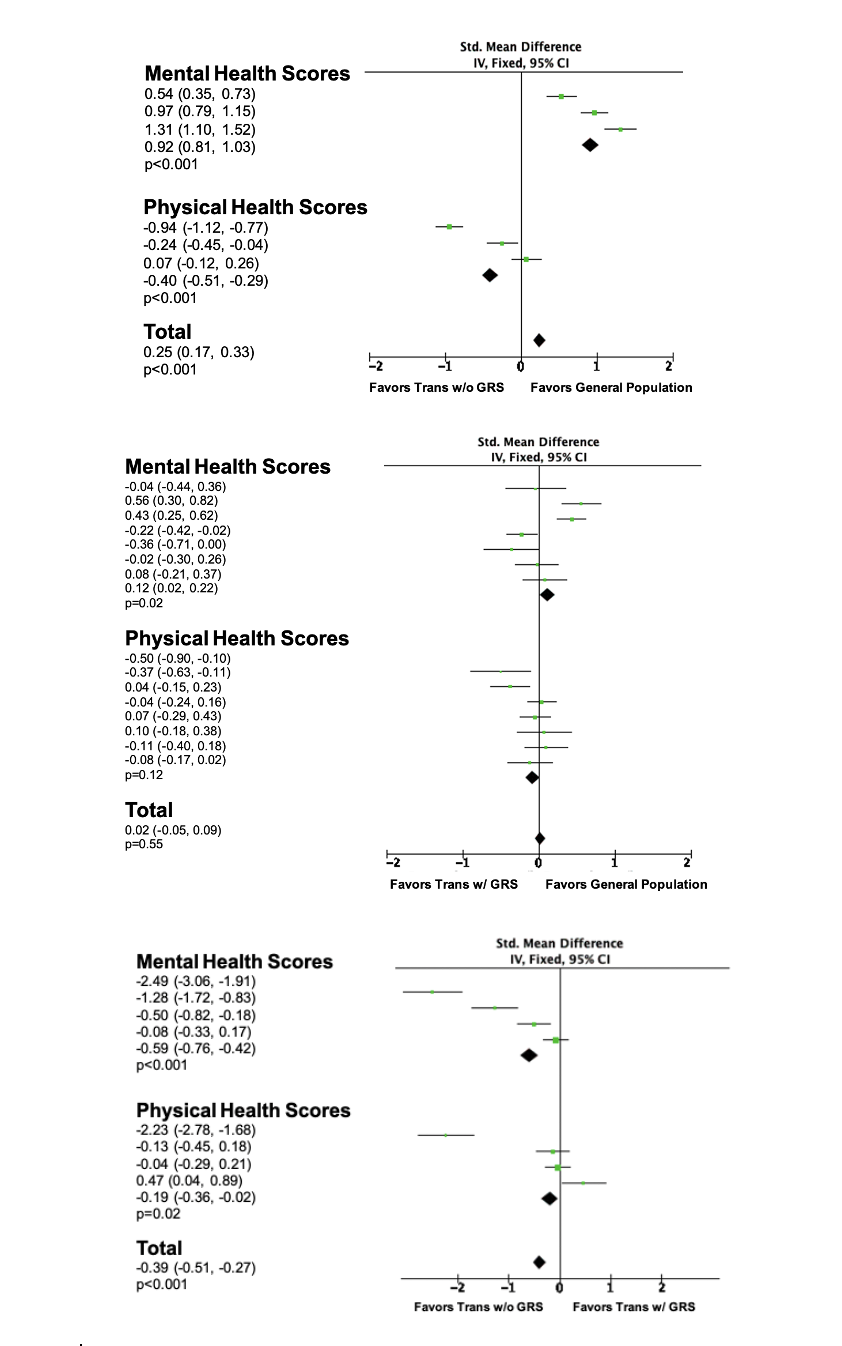
Introduction: With new legislation put forth targeting the ability of transgender individuals to seek gender-affirming care, we sought to explore outcomes of bottom surgery (phalloplasty, metoidioplasty, vaginoplasty, vulvoplasty) and its effect on health-related quality of life. Methods: Utilizing Meta-analysis of Observational Studies in Epidemiology (MOOSE) criteria, we performed a search of major biomedical databases for all relevant literature published from 1995 to 2021. Inclusion criteria were original research articles, studies of transgender patients receiving pelvic gender affirming surgery, and use of the SF-36 survey. We excluded case reports, analyses of clinical outcomes following non-pelvic gender-affirming surgery, or nonsystematic review articles. Following this, data were pooled where appropriate. Data was compiled using a comprehensive meta-analysis software (Revman). Results: Our literature search identified 56 titles and 7 full articles that were included in the final review. Three studies provided SF-36 data scores including the general population and transgender patients without bottom surgery. Our analysis of 11,186 patients showed SF-36 scores were significantly higher in the general population in comparison to transgender patients without a history of gender-affirming surgery [0.25 (CI 0.17, 0.33), p<0.001). Seven studies provided SF-36 data scores including the general population and transgender patients after bottom surgery, with our analysis of 16,450 patients showing no significant difference in SF-36 scores between the general population and transgender patients post gender-affirming pelvic surgery [0.02 (CI -0.05, 0.09; p=0.55]. Lastly, of these studies, four provided SF-36 data on transgender patients before and after gender-affirming pelvic surgery. Our meta-analysis of 677 participants showed that bottom surgery resulted in significant improvements in overall SF-26 scores [-0.39 (CI -0.51, -0.27); p<0.001]. Conclusions: Gender-affirming surgery was associated with significant improvements in mental and physical health outcomes. Our meta-analysis supports the role of bottom surgery in improving health-related quality of life back to normal range. SOURCE OF Funding: UC San Diego School of Medicine Research Award