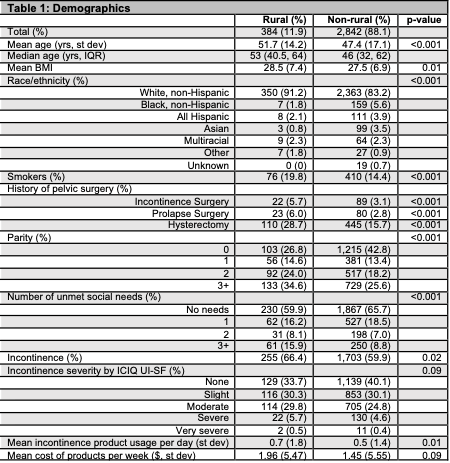
Introduction: Urinary incontinence (UI) affects over half of all adult women in the United States, posing a significant public health burden. There is a growing appreciation of how social determinants of health (SDOH) may help us understand healthcare disparities and the impact on health outcomes, including urinary conditions. Rurality has been associated with SDOH and poorer health outcomes. This study’s aim was to examine social risk factors and unmet social needs in rural women, and how they may impact the rate and severity of UI in a large, community-based sample. Methods: This secondary analysis of a sample of 3,226 cis-gendered women living in the U.S. was electronically recruited via ResearchMatch for a study investigating unmet social needs and urinary symptoms. Respondents were excluded if they were currently pregnant or had a history of cystectomy. Sociodemographics, urinary symptoms and severity of incontinence (ICIQ UI-SF), unmet social needs, and incontinence product usage was compared between women living in rural versus non-rural communities. Results: Of the study cohort, 384 (12%) reported living in a rural community. Rural participants were older (p < 0.001) and more often identified as white, non-Hispanic (p < 0.001). Additionally, rural women had less education (p < 0.001), were more often unemployed, retired, or on disability (p < 0.001), and more often uninsured or using Medicaid/Medicare (p < 0.001) over non-rural women. Women in rural communities had a higher rate of UI (66% vs. 60%, p=0.02) and trended towards more severe UI as assessed by ICIQ UI-SF score. Rural women also reported higher daily UI product usage (p=0.01) in addition to higher costs of UI products weekly, although this was not significant. Finally, women in rural communities reported a greater number of unmet social needs, with 16% reporting 3 or more needs (p < 0.001). Conclusions: This study demonstrates that women living in rural communities have more social risk factors and unmet social needs that may affect UI. In our cohort, rural women had a higher rate of UI and a greater UI product burden, with a trend towards increased UI severity. This information will guide further research into the unmet social needs that affect women with UI in rural communities, with the goal of providing more comprehensive care. SOURCE OF Funding: UL1 TR000445 from NCATS/NIH