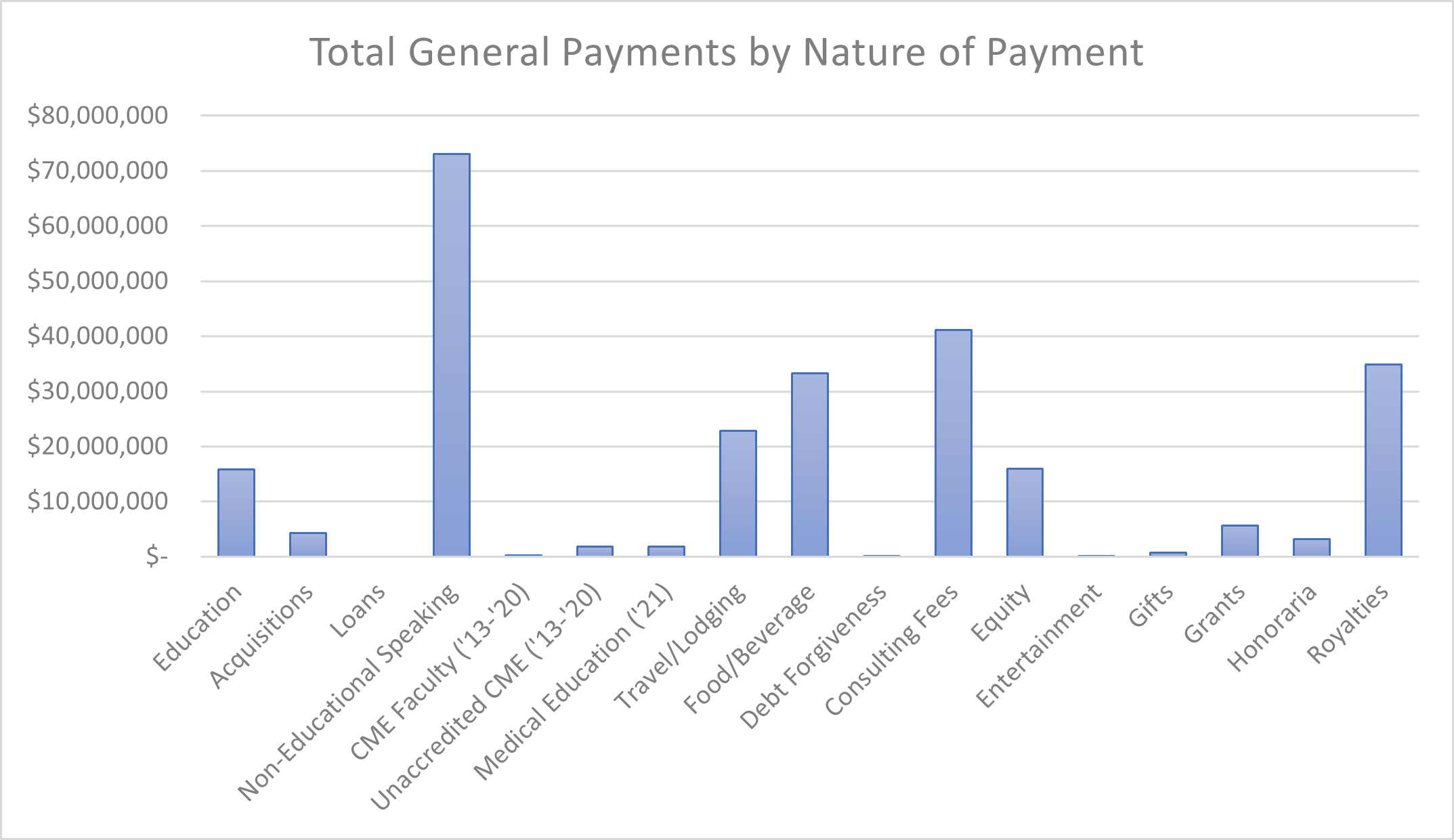
Introduction: The Open Payments Program (OPP) was established in 2013 under the Sunshine Act which mandated that medical device and pharmaceutical manufacturers submit record of any financial incentive given to physicians to the Centers for Medicare and Medicaid Services in order to be made publicly available. The study aim is to characterize general (i.e., non-research) payments to urologists over the first 8 full years of OPP data. Methods: The study sample included all urologists in the US who received at least one general payment in the OPP database from 2014 to 2021. Payments were analyzed by geography, payment type, physician, and industry payer with nominal payments adjusted to the base year’s US dollar using the Bureau of Labor Statistics’ Consumer Price Index – Urban (CPI-U). Results: Real payments totaling $254,659,868.24 were made to 14,178 urologists over the study period in 2014 US dollars. The mean payment was $158.94 (SD, $6,111.49), and the median payment was $15.63 (interquartile range, $11.82-$23.05). The significant difference between the mean and median was due to the presence of outliers. Specifically, the top 100 paid urologists (0.7% of total number of urologists included in the study) received 48% of all payments. The top contributing companies were Boston Scientific, Cook Inc., and Astellas Pharma US. 16% ($41,094,060.54) was paid to urologists as consulting fees, and 14% (34,800,128.79) was paid to urologists as royalties or licensing fees. Over 50% of the real value of payments were non-continuing medical education (CME)-related compensations (e.g. food and beverage, non-CME speaking fees, travel and lodging). Educational payments and compensation for serving as a faculty or as a speaker for an accredited or certified CME program only came in at $15,876,054.34 (6%) and $1,868,132.32 (1%) over the study period. Urologists in the AUA New England Section received the highest average real payments during the study period. Conclusions: This study is the first to characterize the real payments made to all urologists since the passage of the Sunshine Act. Around 1% of the urologists included in our study received around 50% of the total payments, which might indicate an unequal distribution of payments. Further studies are needed to understand the relationship between industry and urologists, as the payments may translate to influence in medical decisions. SOURCE OF Funding: None