Department of Urology, Hokkaido University Graduate School of Medicine
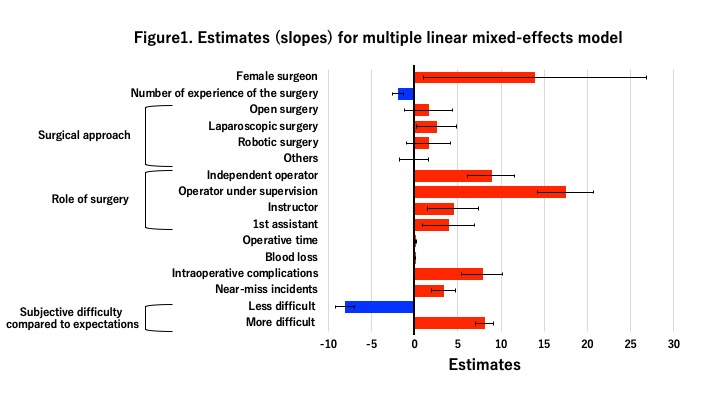
Introduction: In urology, new technologies such as laparoscopic and robotic surgery are spreading, and physicians manage to catch up with novel methods. While professional burnout is recently emphasized, the mental and physical costs during surgery are not well understood. Our aim was to clarify the mental workloads (MWLs) of urologists during surgery and predictive factors. Methods: Urologists in Hokkaido, Japan, joined this study. Between December 2020 and December 2021, after each surgical case, they reported patients’ backgrounds, their role (independent operator, operator under supervision, instructor, 1st, 2nd assistant), surgical outcomes (procedure, operative time, blood loss, complications, near-miss incidents etc.), subjective procedure difficulty, and MWLs, which was assessed by National Aeronautics and Space Administration-Task Load Index (NASA-TLX), via SurveyMonkey®. A multiple linear mixed-effects model was utilized to analyze the factors associated with NASA-TLX. Results: 65 urologists (5 women) joined the study, and 2159 data were collected in 7 days after surgeries (open=250, laparoscopy=315, robotics=407, transurethral surgeries=743, and others=444). A multiple linear mixed-effects model revealed that female surgeons (estimate: +13.90, p=0.035), laparoscopic surgery [+2.54 (reference: transurethral surgery), p=0.035], intraoperative complications (+7.83, p<0.001), near-miss incidents (+3.34, p<0.001), longer operative time (continuous, +0.06, p<0.001), and higher blood loss (continuous, +0.001, p=0.01) were associated with higher MWLs. Operator under supervision (+17.42, p<0.001), independent operator (+8.86, p<0.001), instructor (+4.46, p=0.003), and 1st assistant (+3.90, p=0.01) also showed higher MWLs than 2nd assistant (reference). MWLs correlated with subjective surgical difficulty, with higher scores (+8.05, p<0.001) when the procedure was more difficult, and lower scores (-8.05, p<0.001) when it was less difficult than expected. MWLs was lower as the number of previous surgeries increased (-1.90, p<0.001). Conclusions: Surgeon MWLs were influenced by multiple factors. Regarding the role of surgery, operators showed higher MWLs, especially under supervision. Instructors should be aware of the high MWLs of operators under their supervision and devise instructional interventions. SOURCE OF Funding: None