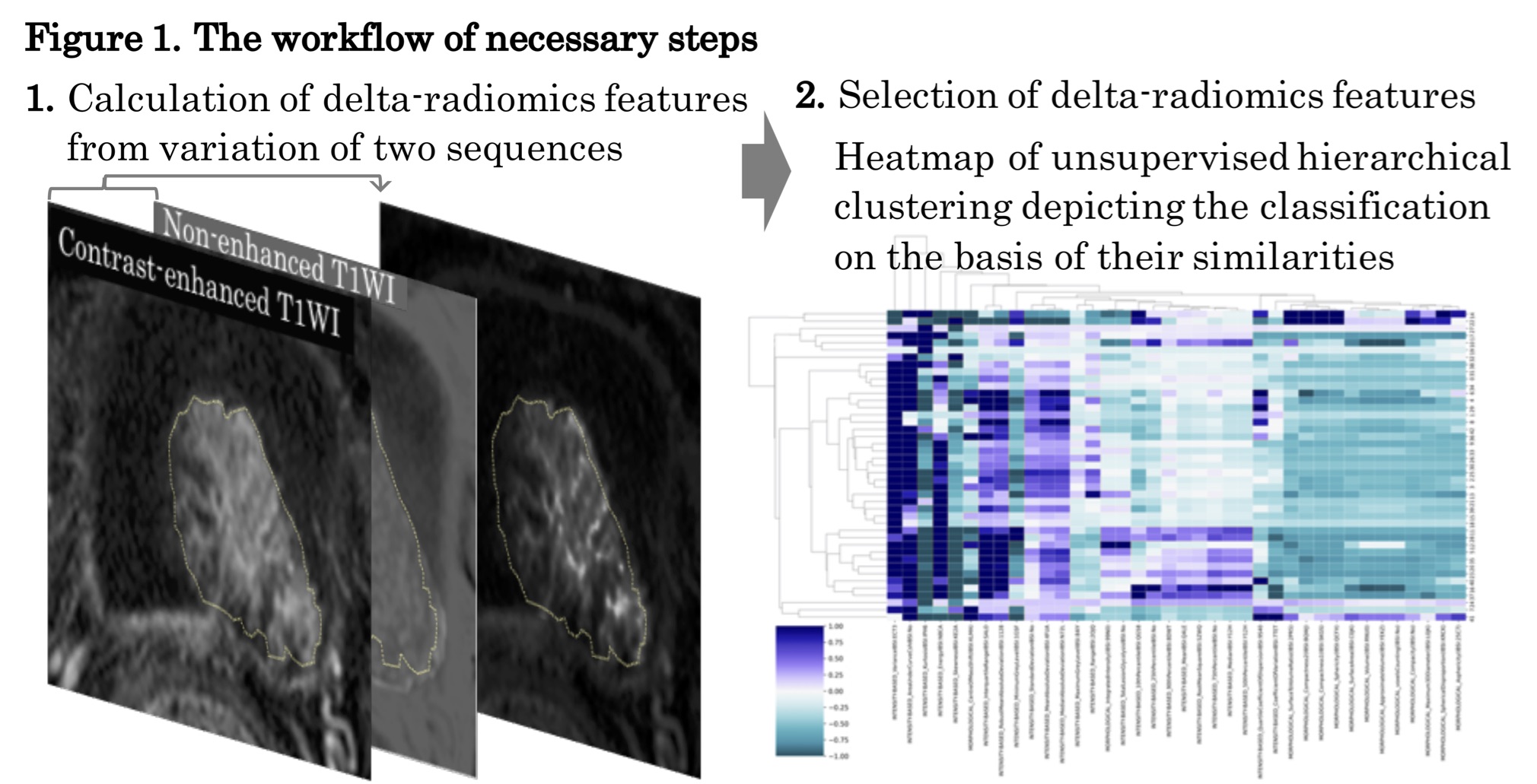
Introduction: Radiomics is the extraction of quantitative features from radiological images. Recently, a new technique called delta-radiomics, which analyzes the feature variation at different acquisition times, has been invented. Multimodal bladder-sparing therapy consisting of transurethral resection, chemo- and radiotherapy has been recommended as an alternative treatment for muscle invasive bladder cancer (MIBC). Response to chemoradiotherapy (CRT) is key to oncological outcome. The application of delta-radiomics to contrast-enhanced (CE-) and non-enhanced (NE-) T1-weighted images (T1WI) would enable accurate blood flow assessment, and here we investigated whether feature variation was useful in predicting therapeutic efficacy to CRT. Methods: We reviewed 43 non-metastatic MIBC patients (cT2-4N0M0) who underwent partial or total cystectomy after CRT (approval # M2000-1717). Complete response (CR) to CRT was defined as the absence of residual viable tumor cells in the cystectomy specimen. The volume of interest (VOI) was set for the index cancer on pretherapeutic CE-T1WI, then the same VOI was applied to NE-T1WI. From the radiological features of CE- and NE-T1WI, 46 delta-radiomics features were calculated, and put into various machine learning algorithms to create the best model for CR prediction. The predictive ability of a model constructed from CE-T1WI alone was also calculated. Results: CR was achieved by 21 patients (49%). The best-performing model was obtained using gradient boosting classifier, with an area under the curve (AUC) of 0.80 (95% confidence interval [CI] 0.70-0.90), which employed the following 3 features; “Compactness”, indicating how spherical the tumor shape was, “Kurtosis”, showing the sharpness of the histogram of signal intensity, and “AUC of cumulative standardized uptake value-volume histogram”, indicating the heterogeneity of tumor contrast. The best AUC for the model obtained from CE-T1WI alone was 0.63 (95%CI 0.51-0.75). Conclusions: Delta-radiomics had better predictive ability than the CE-T1WI alone model. Angiogenesis and vascular architecture of bladder tumor may play a key role in the therapeutic efficacy of CRT. Delta-radiomics showed potential usefulness in predicting therapeutic efficacy for CRT in MIBC. SOURCE OF Funding: None