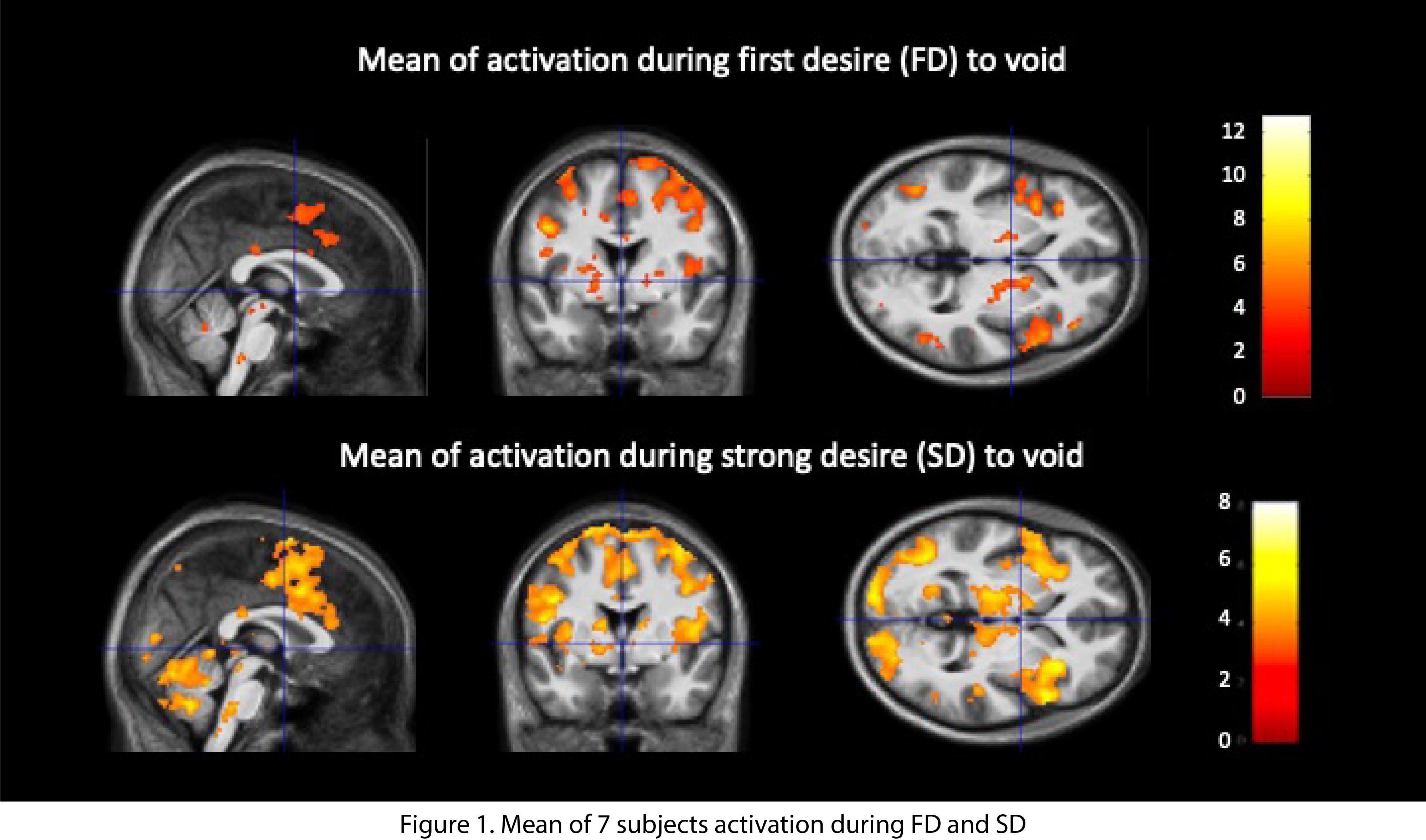
Introduction: Despite being long utilized to study the central control of bladder perception in response to repetitive bladder filling, the reliability and repeatability of functional MRI (fMRI) studies remain problematic. To our knowledge, most of the studies used a block design consisting of discrete epochs of on-off tasks. As proprioception of the bladder filling is immensely subjective, a desire to void event can only be indicated by the participant. In this pilot study, we aim to evaluate the brain response to even-related bladder filling fMRI paradigm. Methods: Seven healthy female subjects with mean age 30.1 years were included. Ethical approval was obtained. All subjects underwent a baseline urodynamic study and the catheters were maintained for the subsequent MRI session. We used a 3 Tesla scanner with an in-bore screen and response buttons. Each fMRI session lasted 8.5 minutes and was repeated 2-4 times, depending on the subjects’ coping ability with the task. The paradigm consisted of repetitive bladder filling (60ml/minute) until first desire (FD) and strong desire (SD) was indicated, followed by a plateau (5 seconds) and withdrawal of 30 seconds (30ml). To prevent constant engagement of the viscerosensory cortex, a diversion visuomotor task was presented to which the subjects had to respond with the button press. All responses were recorded with Psychopy and further incorporated in data analysis. MRI preprocessing was done with fMRIPrep pipeline (version 20.2.6). SPM12 was used to smooth the data with a 6mm Gaussian filter and to analyse them. A General Linear Model was used to model the FD, SD and distraction tasks as events. Second-level mixed effect analysis was then performed for the 3 event-contrasts and significance was set to cluster level P < 0.05 false discovery rate correction. Results: On average subjects indicated FD 3.75 times and SD 4.71 times. The distraction task occurred on average 23.47 times. Figure 1 depicts the brain regions that show stronger mean activation during FD and SD from 7 subjects, including insula, thalamus, cerebellum, pontine micturition center, supplementary motor area and anterior cingulate cortex. Conclusions: Here we designed a sensation-driven fMRI paradigm that enables evaluation of bladder proprioception during FD and SD. The results were robust despite small number of subjects. SOURCE OF Funding: Departmental Funding