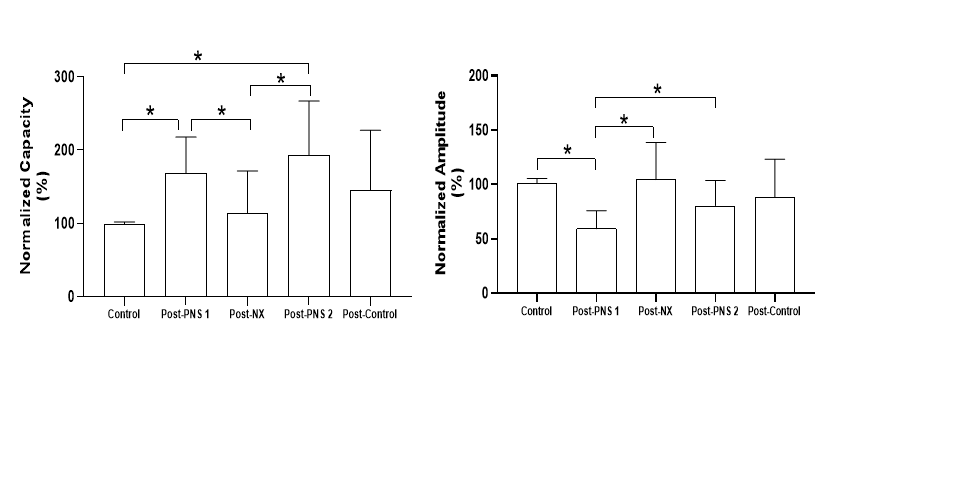
Introduction: Fowler Syndrome, or non-obstructive urinary retention, is seen in young female patients. Although the cause is unknown, it is theorized that aberrant sensory nerves from the urethral sphincter cause inhibition of the central nervous system, thereby leading to urinary retention. Prior studies have suggested that the opioid receptor may be implicated in bladder overactivity and underactivity. We aimed to evaluate opioid receptor inhibition on bladder function in a feline model of Fowler’s Syndrome. Methods: A total of 10 cats were anesthetized, ureters externalized via laparotomy, and urethral catheter placed. A tripolar cuff electrode was placed on the pudendal nerve. Multiple cystometrograms (CMGs) were performed to determine baseline bladder function (Control). Multiple pudendal nerve stimulations (PNS) were performed at 30-minute cycles (5 Hz, 0.2 ms) were applied at 4-6 times the intensity required to elicit anal contraction for 2-5 hours. The result was a stable, underactive bladder state (Post-PNS 1). Next, naloxone (1mg/kg IV) was administered, and CMGs obtained (Post-NX). A single 30-minute PNS was then performed to evaluate the combined effect of naloxone and PNS (Post-PNS 2). Lastly, a CMG was performed to examine any recovery (Post-Control). Primary outcomes were bladder capacity and contraction amplitude (contractility). Results: Application of PNS produced a significant increase in bladder capacity and decrease in bladder amplitude, indicative of a state of bladder underactivity (Figure 1, * denotes significance p<0.05). Administration of naloxone significantly reduced the bladder capacity and increased contraction amplitude. Re-application of PNS led fully overcame the naloxone effect on capacity; however, the amplitude is a combined effect. This effect of re-stimulation lasted only for a short period (15-20 minutes) and Post-Control demonstrate a reduction in capacity indicating effects of the still present naloxone overcoming the PNS. Conclusions: Pharmacologic opioid receptor antagonism increased bladder contractility and reduced bladder capacity to baseline in our feline model of non-obstructive urinary retention. This is a new target for possible pharmacotherapy in the treatment of patients with Fowler's Syndrome. SOURCE OF Funding: 5R01DK121698-02