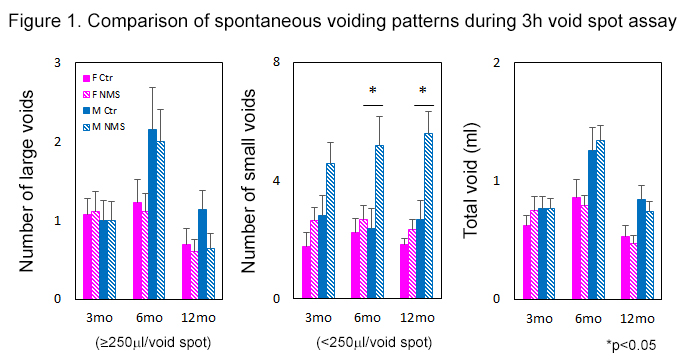
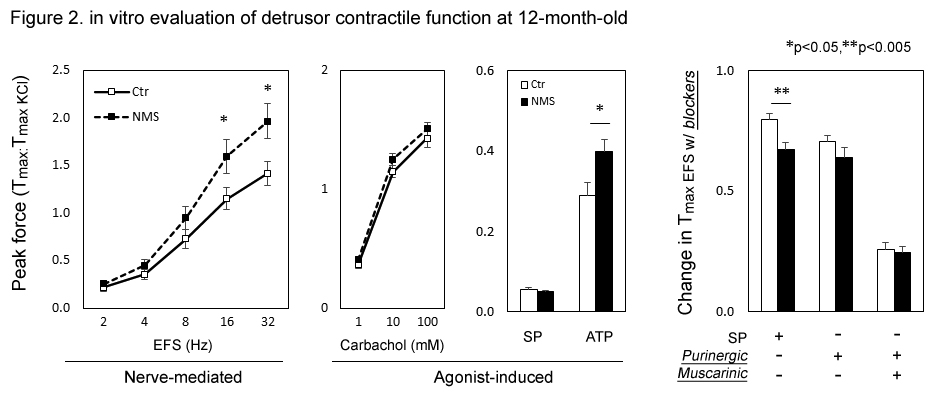
Introduction: The aim of this study was to investigate long term outcome of voiding dysfunction during early childhood in mice. Despite the association between childhood dysfunctional voiding and lifelong bladder dysfunction with or without renal failure, the underlying mechanism remains poorly understood. Neonatal maternal separation (NMS) disturbs the physiological voiding cycle in mouse pups; which is normally maintained by perigenital-bladder reflex via their mother licking the perineum. Methods: Newborn mouse pups were divided into control and NMS groups after birth. NMS pups were removed from their dam and housed individually (6 h/day) from postnatal day 2 to 14. Pups in the control group stayed with their dam all the time. Long-term effects of early life voiding dysfunction on LUT were assessed in vivo by void spot assay at 3-, 6-, and 12-months old, and in vitro by detrusor contractility studies using bladder strips at 12 months old. Results: NMS male mice showed urinary frequency with small voids by 1.6 to 2.2-fold through middle-age (12mo ˜ 40yr-old human) (Fig.1). There was a trend towards increased number of small voids in females experienced NMS compared to the control group, however, the change was statistically insignificant (1.2 to 1.5-fold, p>0.05). A significant increase in nerve-mediated (electric field stimulation, EFS) and purinergic agonist (ATP)-induced detrusor contractility was observed in NMS group compared to the control group (1.4-fold, p<0.05). There were no changes in contractility in response to carbachol or substance-P (SP), however, preincubation of the bladder strips with SP induced a 1.6-fold larger decrease in nerve-mediated contractility (TmaxEFS) in NMS group than that in the control group (p < 0.005, Fig.2). Conclusions: Our results provide evidence that the early life disturbance of normal voiding cycle had prolonged impacts on LUT function accompanied with an enhanced involvement of purinergic and peptidergic neurons/signaling in detrusor contractility in later of life. SOURCE OF Funding: Ponzio Family Endowment Fund (D.W.).