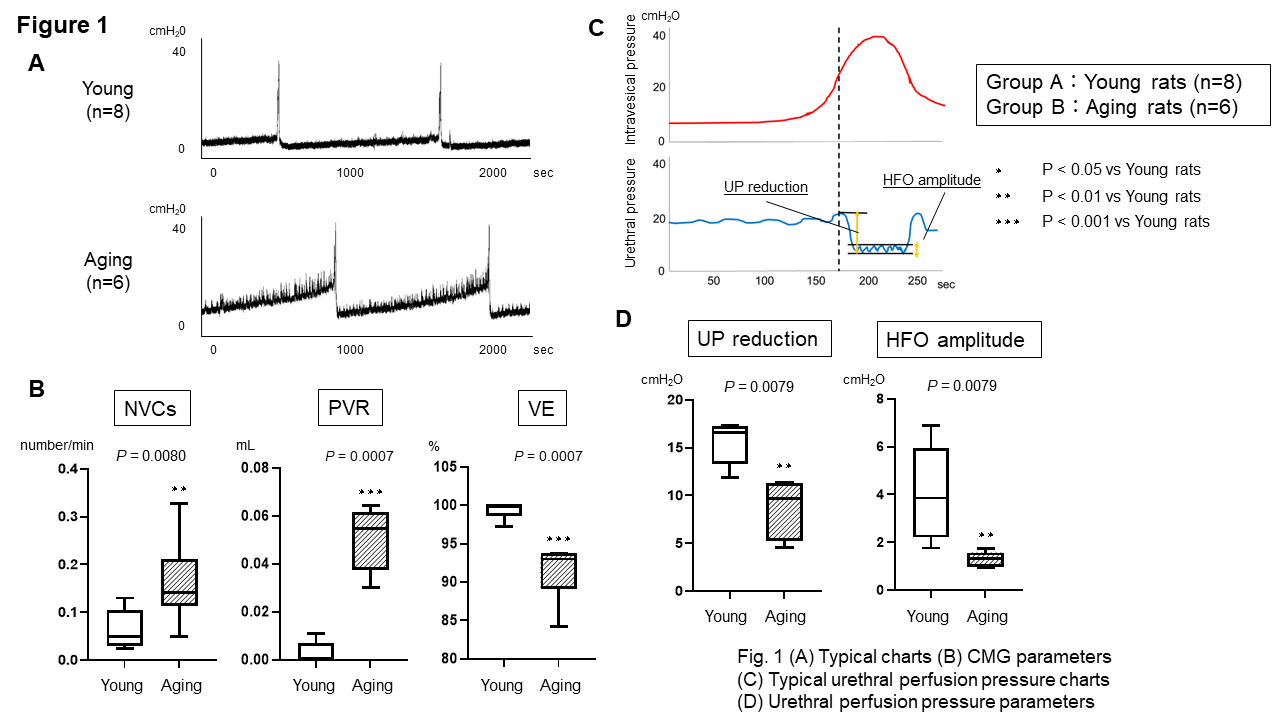
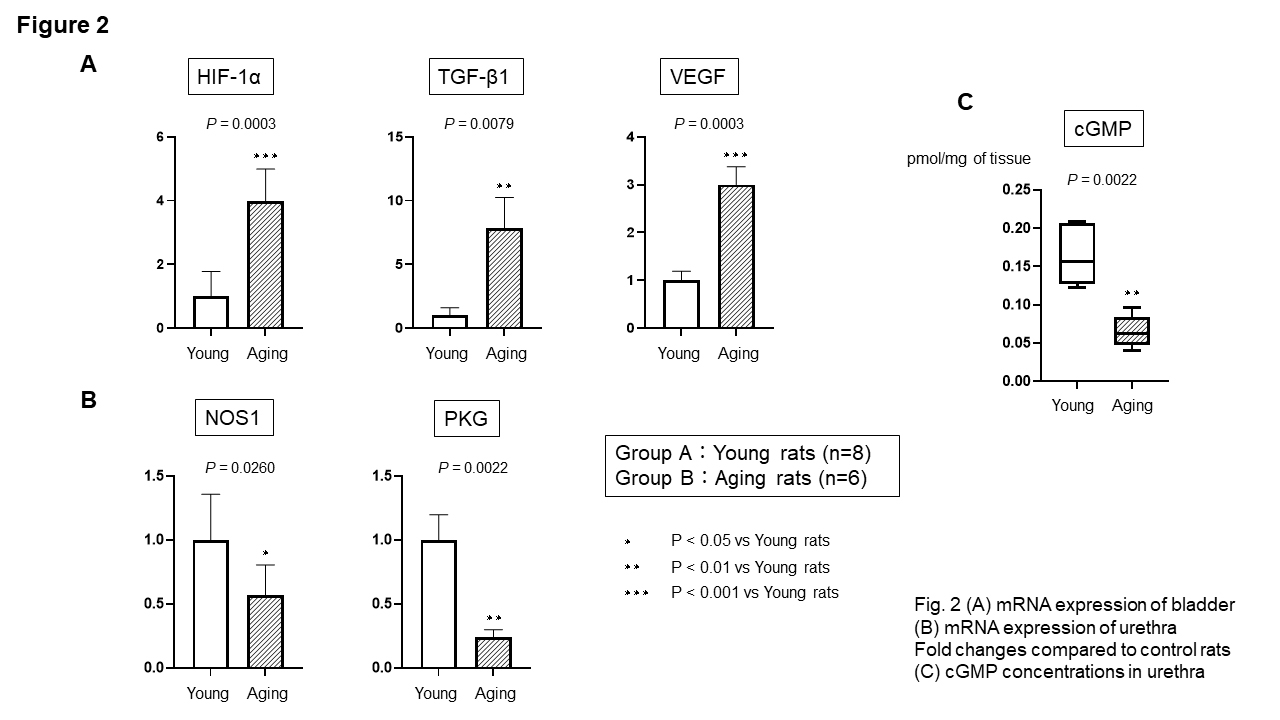
Introduction: Nitric oxide (NO) promotes the intracellular production of cyclic guanosine monophosphate (cGMP) in smooth muscles, reduces the intracellular calcium concentration, and enhances smooth muscle relaxation. However, it remains unknown whether changes in the expression of NO-related molecules are associated with the development of lower urinary tract dysfunction (LUTD) with age. Therefore, we examined changes in bladder and urethral activities, and in NO-related molecule expression using aging rats. Methods: Fourteen Female Sprague–Dawley rats were divided into two age groups: (A) young rats (12 weeks old, n = 8) and (B) aging rats (15 months old, n = 6). In both groups, 24 h voiding assay was performed, and the urodynamic parameters were evaluated using cystometry (CMG) and urethral perfusion pressure (UPP) recordings. mRNA expression levels of NO-, ischemia-, and inflammation-related markers in bladder and urethra tissues were assessed, and the cGMP level in the urethra was measured. Results: There was no significant difference in the 24-h voiding assay results between the groups. In CMG, the number of non-voiding contractions (NVCs) per voiding cycle and post-void residual (PVR) were significantly higher, and voiding efficiency (VE) was significantly lower in Group B than in Group A (Fig. 1A, B). In the UPP recordings, urethral pressure (UP) reduction and high frequency oscillation (HFO) amplitudes were both significantly lower in Group B than in Group A (Fig. 1C, D). In molecular studies, mRNA expression levels of HIF-1a, VEGF, and TGF-ß1 in the bladder were significantly higher in Group B than in Group A (Fig. 2A). mRNA expression levels of NOS1 and PKG were significantly lower in Group B than in Group A (Fig. 2B). In addition, the concentration of cGMP in the urethra was significantly lower in Group B than in Group A (Fig. 2C). Conclusions: Aging rats would be a useful model for the study of the natural progression of age-related LUTD, for which impaired NO-mediated transmitter function is likely to be an important mechanism. SOURCE OF Funding: None