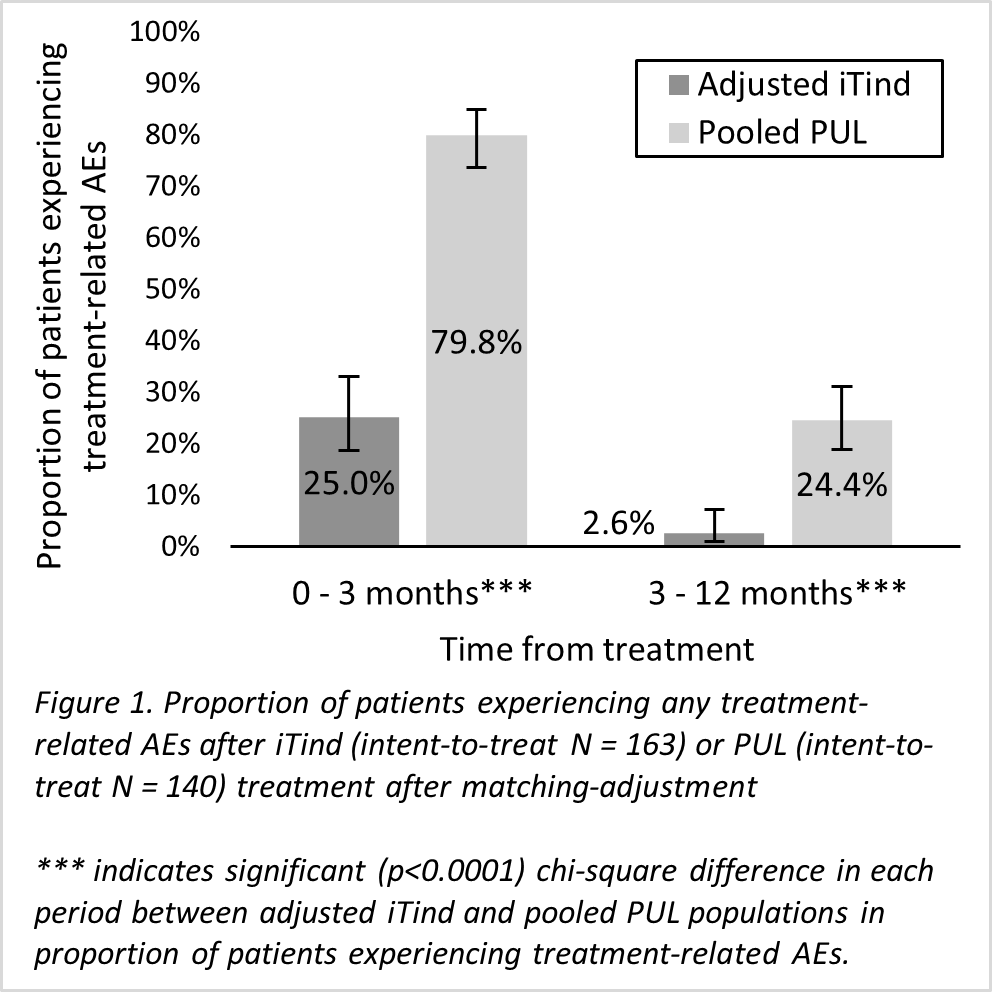
Introduction: To compare the safety and efficacy of the temporarily implanted nitinol device (iTind) versus prostatic urethral lift (PUL) for minimally invasive surgical treatment of lower urinary tract symptoms secondary to benign prostatic hyperplasia. iTind treatment uses a single temporary implant removed after 5-7 days, while PUL uses multiple permanent implants. Methods: Matching-adjusted indirect comparison (MAIC) was used to account for population differences across seven clinical trials identified by systematic literature review. Individual patient data from two iTind trials and aggregated data from five PUL trials were included. Safety and efficacy outcomes at 12 months post-treatment were compared between the matching-adjusted iTind population and pooled PUL population. Results: iTind patients were significantly less likely than PUL patients to experience treatment-related adverse events (AEs) within three months (25.0% vs 79.8%; p<0.001), including dysuria (17.8% vs 34.7%; p =0.001), hematuria (12.0% vs 25.9%; p=0.002), and pain (9.5% vs 18.7%; p=0.023). Rates of treatment-related AEs from three to 12 months were also significantly lower among iTind than PUL patients (2.6% vs 24.4%; p<0.001). iTind and PUL efficacy outcomes were statistically equivalent on changes from baseline to 12 months on the International Prostate Symptom Score (IPSS, p=0.56), quality of life (QoL, p=0.21), Qmax (p=0.39), post-void residual volume (PVR, p=0.16), and the Sexual Health Inventory for Men (SHIM, p=0.14). Conclusions: This MAIC found superior safety and reduced risks of early and later treatment-related AEs with iTind versus PUL. The twelve-month efficacy was equivalent on subjective urinary symptoms (IPSS, QoL) and objective urinary symptoms (Qmax, PVR) and preservation of sexual function (SHIM). This study finds that the iTind temporary device provides an improved safety profile with equivalent efficacy compared to PUL permanent implants for patients with benign prostatic hyperplasia with lower urinary tract symptoms. SOURCE OF Funding: Financial support for this research was provided by Olympus Corporation of the Americas