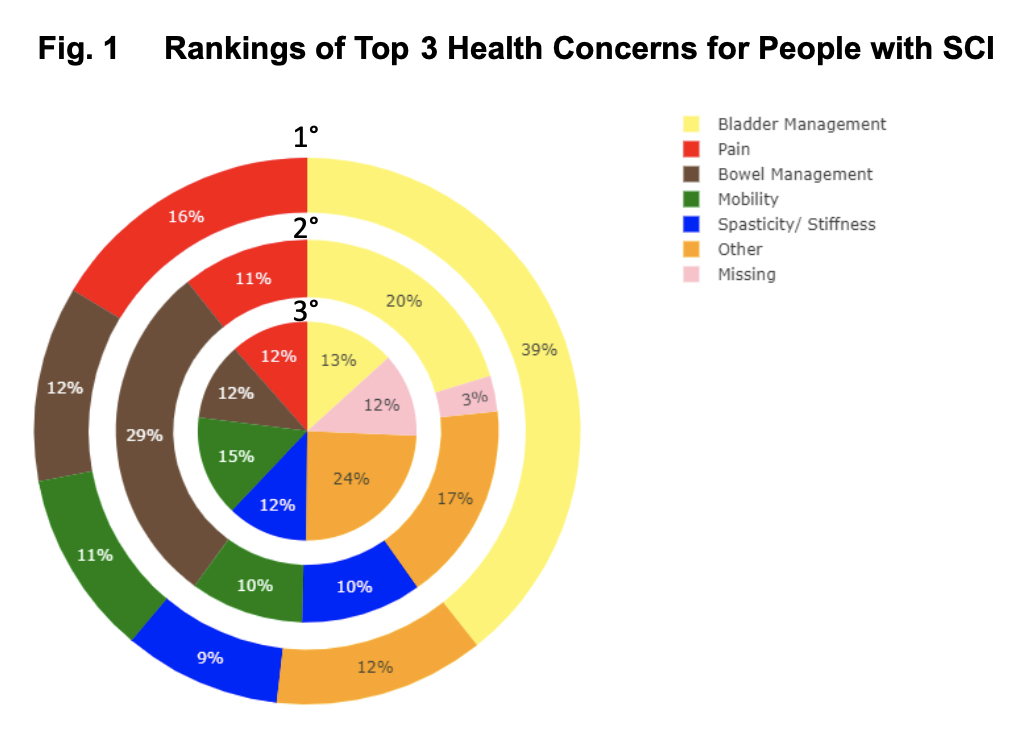
Introduction: Bladder management has been shown to be the most important health concern for people with spinal cord injury (SCI), outranking even ambulation. Incontinence, urinary tract infections (UTI) and clean intermittent catheterization (CIC) compared to other bladder management methods, have been shown to predict poor urinary quality of life (QoL) in people with SCI. But, it is unclear if these factors impact ranking bladder management as a top health concern. Using the Neurogenic Bladder Research Group (NBRG) SCI registry, our objective was to confirm whether bladder management is the top health concern and whether this is associated with urinary incontinence, UTI, or CIC utilization. Methods: Participants in the NBRG registry were asked: “What are the top 3 problems that affect you on a daily basis? (Rank top 3): bladder management/issues, bowel management/issues, pressure ulcer, mobility issues, autonomic dysreflexia, spasticity/stiffness, pain, depression/anxiety, heart problems, lung problems, sexual function, fertility, or other.” Incontinence and urinary QoL were assessed using the Neurogenic Bladder Symptom Score (NBSS). We performed a multivariate regression to identify factors related to their primary choice. Results: Among our 1460 participants, 882 (60%) were men, mean age was 44.9 years, and mean time since injury was 14.4 years. 574 (39%) ranked bladder management as their primary issue, followed by pain and bowel management (Fig. 1). Factors associated with choosing bladder as the top concern included more years since injury (OR 1.02 [1.00,1.03], p<0.02), worse NBSS incontinence domain score (OR 1.06 [1.02, 1.09], p<0.01), and worse NBSS QoL (OR 1.20 [1.04, 1.37], p= 0.01); UTI =1/year (OR 1.03 [0.70, 1.50], p=0.89) and CIC (OR 1.40 [0.92, 2.14], p=0.12) were not significant. Conclusions: In this group, bladder management was ranked as the top health issue, over other sequelae of SCI. The farther out from injury people are, the more important bladder management becomes. Bladder QoL and, in particular, incontinence also drive people to view bladder issues as their top health concern. By managing incontinence in people with SCI, urologists can impact the top health concern of people with SCI. SOURCE OF Funding: PCORI-1409-21348