MP52-18: Robot-assisted supratrigonal cystectomy and augmentation cystoplasty for neurological bladder in adults: comparison of extracorporeal vs. intracorporeal diversion
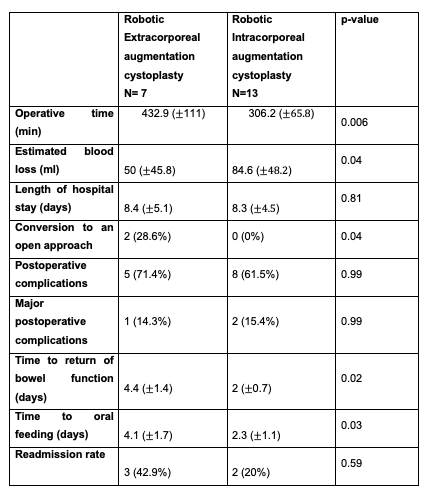
Introduction: There is very little data on robot-assisted supratrigonal cystectomy and augmentation cystoplasty (RASCAC) in adult neurological patients. The objective of this study was to compare the perioperative outcomes of RASCAC with extracorporeal (RASCAC-EXTRA) vs. intracorporeal (RASCAC-INTRA) diversion in adults. Methods: The charts of all patients who underwent a RASCAC for neurogenic lower urinary tract dysfunction (NLUTD) between October 2015 and April 2021 in three centers were retrospectively reviewed. The diversion was done extracorporeally between 2015 and 2019 ù`and intracorporeally thereafter. The preoperative and 3 months postoperative assessments included bladder diaries. urodynamics and the ICIQ-SF. Qualiveen SF and USP questionnaires. The continence status postoperatively was categorized as complete continence (no pad). improved continence or unchanged continence Results: Twenty patients were enrolled over the study period: seven RASCAC-EXTRA and 13 RASCAC-INTRA. Two conversions to an open approach were required in the RASCAC-EXTRA group (28.6% vs. 0%; p=0.04). The operative time was shorter in the RASCAC-INTRA group (306.2 vs. 432.9 min; p=0.006). The length of hospital stay was comparable in both groups (8.3 vs. 8.4 days; p=0.81). The rate of post-operative complications was comparabale in the RASCAC-INTRA and RASCAC-EXTRA groups(61.5% vs. 71.4%; p=0.99). Among these complications. only three were Clavien = 3 (15%), two in the RASCAC-INTRA group and one ni the RASCAC-EXTRA group (15.4% vs. 14.3%; p=0.99). The time to oral feeding and time to return of bowel function were significantly shorter in the RASCAC-INTRA group (2.3 vs. 4.1 days; p=0.03 and 2 vs. 4.4 days; p=0.02 respectively). The rates of complete continence at 3 months wer similar in both groups (75% vs. 57.1%; p=0.31) Conclusions: Robot-assisted supratrigonal cystectomy and augmentation cystoplasty appears to be technically feasible in adult neurological patients. The perioperative outcomes were mostly comparable in the intracorporeal and extracorporeal groups but there was a shorter operative time and shorter times to oral feeding and return of bowel function in the RASCAC-INTRA group SOURCE OF Funding: none