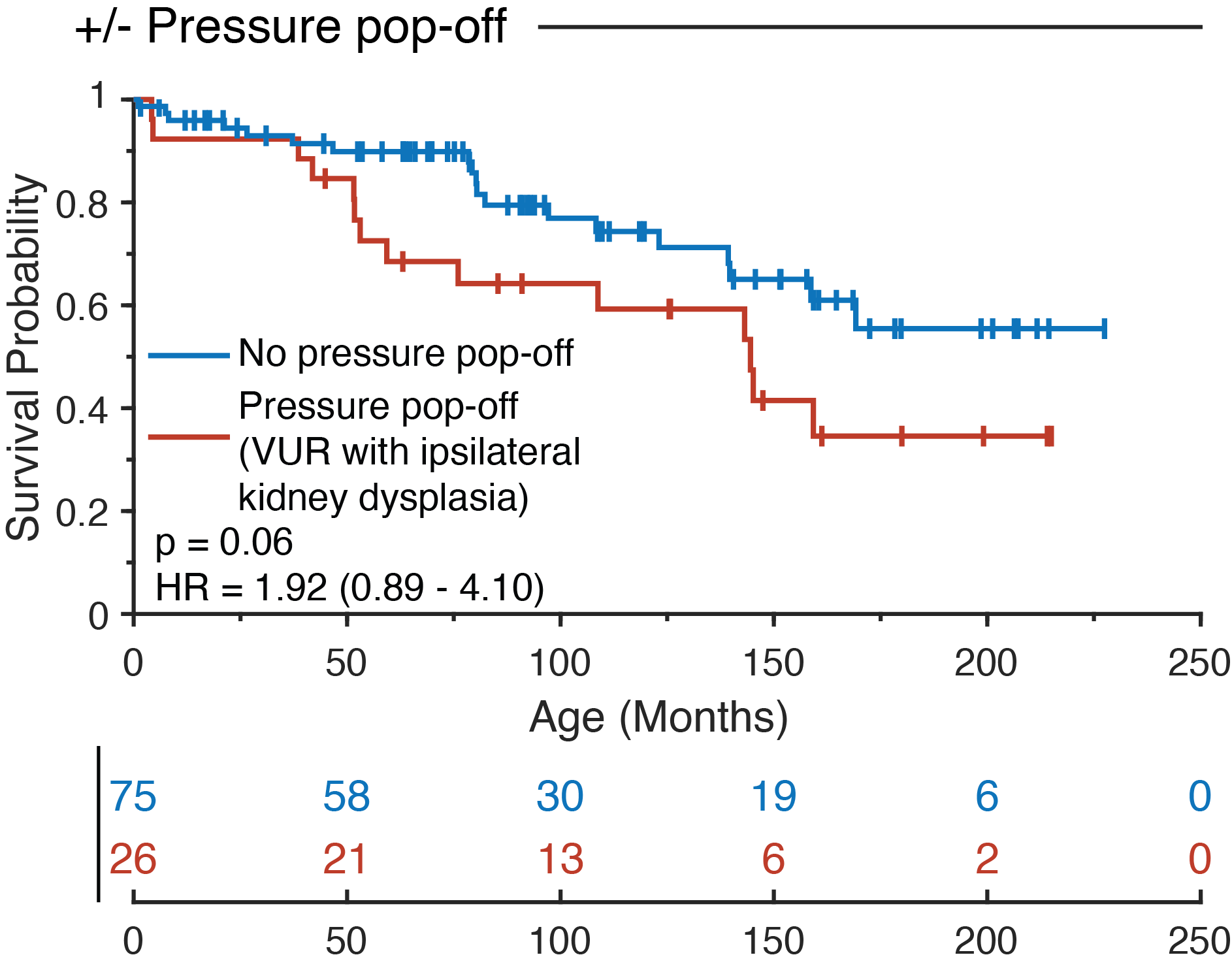
Introduction: The protective role of pressure pop-offs, consisting of vesicoureteral reflux (VUR) and ipsilateral kidney dysplasia, in posterior urethral valve (PUV) is controversial. While there has been significant emphasis on exploring the non-significant association between “pop-offs” and kidney function, there is paucity of data on the impact of this mechanism on bladder function. Here, we analyzed this association by examining the role of pressure pop-offs on long-term bladder outcomes in PUV patients. Methods: A retrospective chart review was conducted for toilet-trained children with PUV managed at our institution between 2000 and 2022, only excluding cases without recorded uroflowmetry studies. Patients were stratified by the presence of pressure pop-offs (high-grade VUR + ipsilateral kidney dysplasia). Outcomes included uroflowmetry parameters and initiation of clean-intermittent catheterization (CIC). Survival analysis was conducted to calculate hazard ratios (HR). Results: We identified a total of 101 patients who met study inclusion criteria, with a median follow-up of 114 months (IQR 67, 169). The median age of first and last uroflowmetry was 57 months (IQR 48, 82) and 120 months (IQR 89, 160), respectively. Patients with pressure pop-offs had similar flow velocity, post-void residuals, and bladder voiding efficiency to other PUV patients at last follow-up uroflowmetry. On survival analysis, patients with pressure pop-offs had no significant difference in risk of requiring CIC compared to patients without pop-offs (HR 1.92, p=0.06). Kidney dysplasia was independently associated with increased risk of CIC (HR 3.16, p=0.02) while VUR was not (HR 1.85, p=0.07) Conclusions: We show that boys with pressure pop-offs are not at higher risk of poorer voiding and intermittent catheterization than others with PUV. By extension, VURD syndrome does not confer protection against poorer bladder function. SOURCE OF Funding: None