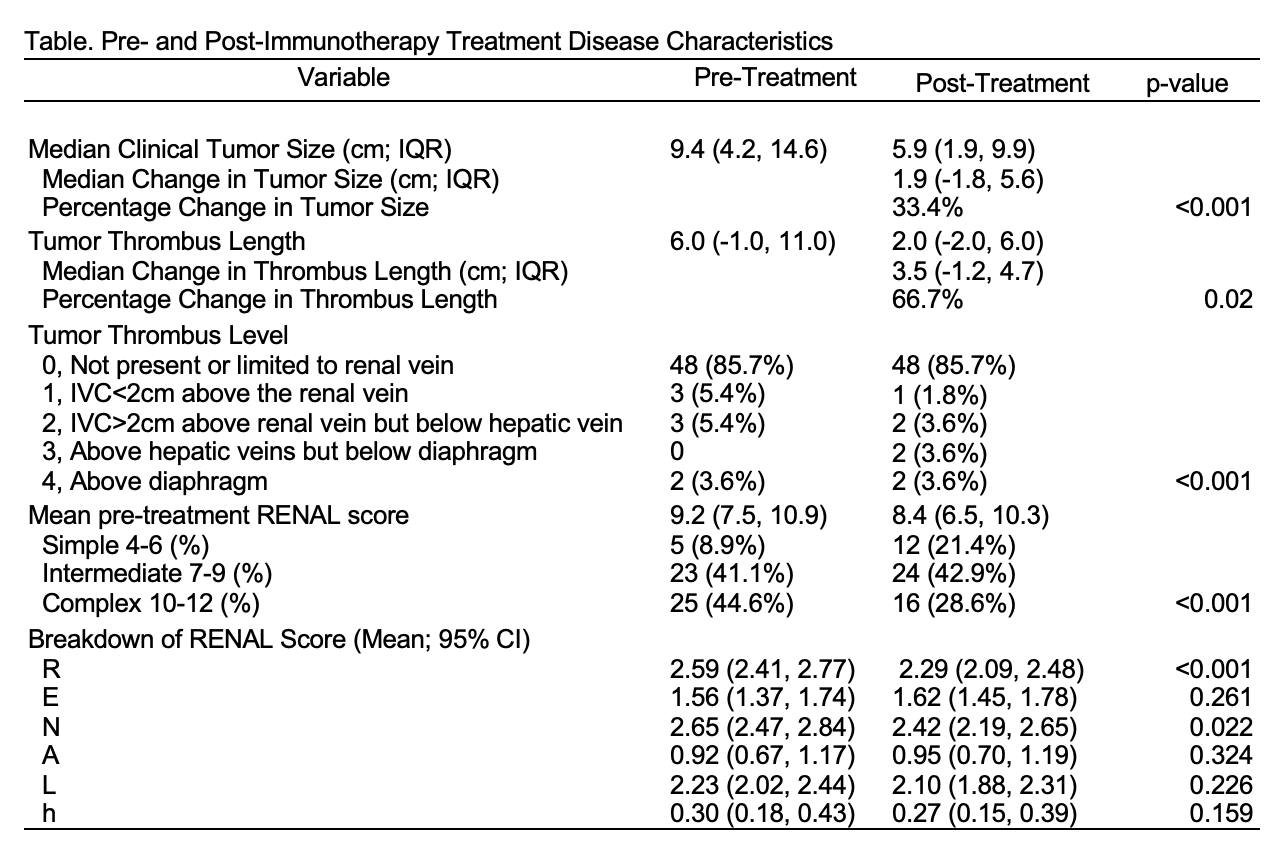
Introduction: Primary systemic therapy in the management of advanced Renal Cell Carcinoma (RCC) has gained increasing traction. We examined the effects of immunotherapy (IO) on the primary tumor, consequent cytoreductive nephrectomy, and short-term oncologic outcomes. Methods: This was a multi-center, retrospective analysis of patients with advanced/metastatic RCC having received IO followed by cytoreductive nephrectomy. Disease characteristics between pre- and post-IO groups was assessed using independent sample t-test. The cohort was divided into patients who achieved the Bifecta outcome (complete surgical resection and no post-operative complications) and those who did not achieve Bifecta. Primary outcome was progression-free survival (PFS). Secondary outcomes included change in primary tumor size, tumor thrombus length, and RENAL score following IO treatment. Cox regression multivariable analysis (MVA) was conducted for predictors of survival outcomes. Kaplan-Meier analysis (KMA) assessed PFS in the setting of Bifecta. Results: 56 patients across 9 institutions were analyzed. Median age was 63 years (median follow-up time of 22.5 months). The most common histology was Clear Cell RCC (76.8%). Most patients received nivolumab and ipilimumab (57.1%) and median duration of IO prior to surgery was 8.1 months. IO resulted in significant reductions in median tumor size (9.4 vs 5.9cm, p<0.001) and tumor thrombus length (6.0 vs. 2.0cm, p=0.02). Patients saw a significant reduction mean RENAL score (9.2 vs 8.4, p<0.001) as well as a reduction in complex RENAL score (10-12) from 44.6% to 28.6% (p < 0.001). Following IO treatment, most patients received open (41.1%) radical nephrectomy (85.7%). 67.9% achieved the novel outcome Bifecta (complete surgical resection and no post-operative complications). MVA noted Bifecta achievement (OR 2.65, p=0.03) as a significant predictor for improved PFS. KMA demonstrated improved 2-year PFS (84% vs 71%, p=0.019) in patients who achieved the Bifecta outcome compared to those who did not. Conclusions: IO resulted in reductions in tumor size, complexity, and thrombus length. Patients who achieved bifecta displayed improved 2-year PFS. Cytoreductive nephrectomy may be an important tool in the setting of primary IO for advanced RCC. SOURCE OF Funding: Stephen Weissman Kidney Cancer Research Fund