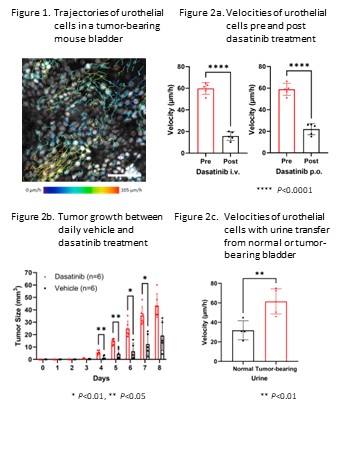
Introduction: Imaging of live animals at microscopic resolution (intravital imaging) found that bladder tumor (BT) development caused a unique collective migration of urothelial cells in a mouse orthotopic bladder cancer model. This study aimed to investigate the relationship between this newly discovered migration and BT growth. Methods: MB49 cells (a mouse bladder cancer cell line) were labeled with a red fluorescent protein to distinguish them from urothelial cells of C57BL/6 mice expressing a cyan fluorescent protein. Labeled MB49 cells were then injected into mouse bladders pretreated with poly-l-lysine (PLL) to initiate BTs. While mice underwent general anesthesia using isoflurane, two-photon excitation microscopy, which enables deep tissue imaging, was performed to visualize the urothelium and the attached MB49 cells. Dasatinib, a Src/focal adhesion kinase signaling inhibitor, was intravenously or orally administered. Results: A collective migration of urothelial cells was observed four days after intravesical injection of 1 × 106 MB49 cells (Fig. 1). Pretreatment with PLL alone did not cause this migration. Intravenous and oral administration of dasatinib each remarkably retarded MB49-induced migration (Fig. 2a). Surprisingly, inhibition of this migration by daily oral administration of dasatinib starting 24 hours after MB49 injection significantly enhanced BT growth despite dasatinib generally inhibiting cell-growth (Fig. 2b). In a subcutaneous xenograft mouse model using MB49 cells, dasatinib slightly suppressed tumor growth. Intriguingly, transfer of urine from which cells had been removed by filtration from an MB49-injected bladder to another C57BL/6 mouse bladder caused the urothelial cell migration (Fig. 2c). Conclusions: Cancer cell injection into the bladder caused a unique collective migration of urothelial cells. Inhibition of this migration enhances BT growth, suggesting that this migration may play a defensive role against BT development. We are currently working to identify the molecule(s) that trigger the migration. Enhancement of this migration may be a novel strategy for preventing BT recurrence after transurethral resection of BTs. SOURCE OF Funding: None