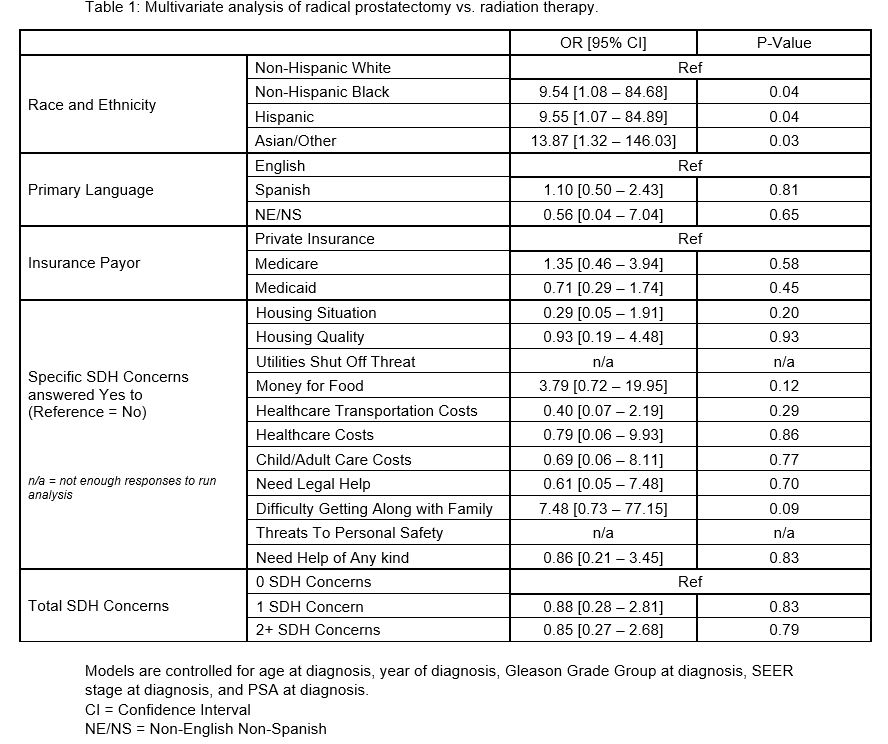
Introduction: Social Determinants of Health (SDH)–defined as the conditions where people are born, work, live, and age–impact patients’ access to resources and health outcomes in a variety of ways. Additionally, ethnic differences in primary treatment for prostate cancer have been demonstrated. We assessed the relationship between SDH score and primary treatment choice for localized prostate cancer in a diverse, urban patient population. Methods: Using our institutional registry, we conducted a retrospective study of men diagnosed with prostate cancer between 2003–2022. Primary treatment choice–defined as either radiation therapy (RT) or radical prostatectomy (RP)–was abstracted with clinical variables. A validated SDH questionnaire, distributed over the past 5 years by our institution’s primary care department, provided self-reported demographics and patients’ concerns regarding specific social risks. Multivariable analyses controlling for age, PSA, and Gleason grade group at diagnosis were performed to analyze the association between SDH variables and primary treatment choice for localized prostate cancer. Results: 217 patients completed the SDH questionnaire and met inclusion criteria; 118 (54%) and 99 (46%) received primary RT and RP, respectively. Median age was 64 years. The cohort was primarily non-Hispanic Black (43%) or Hispanic (41%), English-speaking (80%), and insured through Medicare (65%). Table 1 reports the results of binomial logistic regression models assessing the relationship between the variables of interest and primary treatment selection. Compared to White patients, patients of all other races/ethnicities were more likely to undergo prostatectomy (Non-Hispanic Black OR=9.54, P=0.04; Hispanic OR=9.55, P=0.04; Asian/Other OR=13.87, P=0.03). No specific SDH concern endorsed by patients was significantly associated with treatment choice (P>0.05 for all). Conclusions: Analysis of our cohort indicates that unmet social needs do not influence primary treatment selection for localized prostate cancer. This suggests the presence of other variables that contribute to racial/ethnic differences in treatment choice. Future studies are needed to investigate the social and cultural factors that influence how patients determine primary treatment for localized prostate cancer. SOURCE OF Funding: None