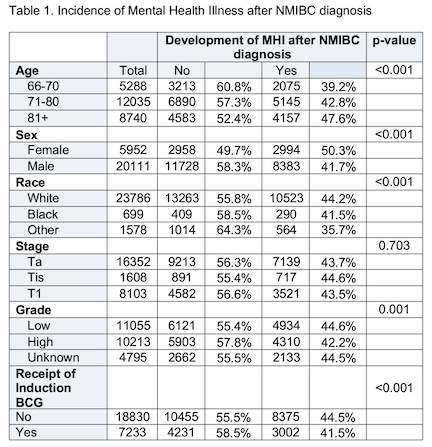
Introduction: Up to a third of cancer patients experience a mental health condition during their cancer treatment; Bacillus Calmette-Guerin (BCG) has been shown to be neuroprotective. Herein, we assess the incidence of mental health illness (MHI) in non-muscle invasive bladder cancer (NMIBC) patients and the impact of intravesical BCG on the development of non-neurodegenerative MHI. Methods: Using the Surveillance, Epidemiology, and End Results (SEER)-Medicare data set, we identified 30,991 patients diagnosed with NMIBC between 2005-2017. MHI diagnosis and BCG treatment were identified using ICD9/ICD10 diagnosis codes and HCPCS codes from Medicare inpatient, outpatient, and physician claims. We excluded developmental, organic, and neurodegenerative MHI. Descriptive statistics were done using the Pearson’s chi-square test for categorical variables. Results: A total of 27.0% of patients (N=8,367) received at least an induction course of BCG. Pre-existing MHI was present in 15.9% (N=4,928) of patients 1 year prior to bladder cancer diagnosis. These patients had lower rates of induction BCG (23.0% VS 27.8%, P<0.001). Excluding pre-existing MHI, 43.7% (N=11,377) of patients developed MHI after their bladder cancer diagnosis. Both female and older patients had higher rates of developing MHI (P <0.001), Table 1. Patients without pre-existing MHI treated with at least an induction course of BCG (N=7,233) had a lower MHI development rate than those who did not receive BCG (41.5% VS 44.5%, P<0.001). Conclusions: Patients with NMIBC are at high risk of developing MHI after diagnosis especially elderly and female patients. Patients who received at least induction BCG treatment had lower rates of developing de novo MHI, however, those with pre-existing MHI were less likely to receive BCG. SOURCE OF Funding: This research was supported by the Wayne B. Duddlesten Professorship in Cancer Research