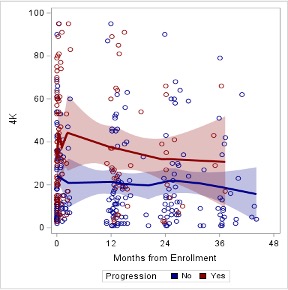
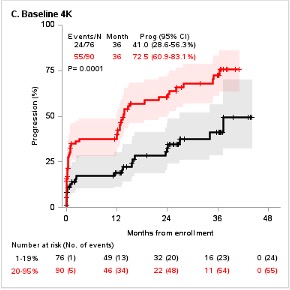
Introduction: Active surveillance (AS) is the preferred management in low and select intermediate risk prostate cancer patients. Currently, the 4Kscore identifies men with grade group 2+ disease in men with clinical suspicion of prostate cancer but little is known about its utility in men undergoing AS. In this study, we assessed the 4Kscore’s ability to predict tumor progression on men enrolled in a prospective active surveillance protocol. Methods: We enrolled patients with biopsy-confirmed very low to intermediate risk prostate cancer who elected for AS and obtained prostate MRI, 4Kscore, and targeted +/- systematic biopsy within 1 year of diagnosis and then yearly for 3 years. The 4Kscore was categorized as low (= <20%) and high (=>20%) risk. We estimated cumulative incidence rates of progression over time by the Kaplan-Meier method and used multivariable Cox analyses to assess the association between the 4Kscore and progression while adjusting for NCCN risk at diagnosis, age, PSA density and baseline PIRADS score. Results: The 4Kscore was collected in 166 men at the time of confirmatory biopsy. Over half the patients had a PIRADS 4 or 5 lesions and 4K score of over 20% at baseline. A total of 79 (47.6%) patients progressed during the study period, with 26.5%, 13.3%, 5.4%, and 2.4% progressing at the baseline, 12-month, 24- month, and 36-month visit, respectively. Patients who progressed had higher baseline 4Kscore compared with patients who did not progress (31% IQR 15-59 vs. 14% IQR 8-35, p<0.001; Figure 1a). Patients with a 4Kscore above 20% had higher cumulative incidence of progression by 36 months compared with patients with 4Kscores less than 20% (72.5% [95% CI 60.9-83.1%] vs. 41.0% [95% CI: 28.6-56.3%], p=0.0001, Figure 1b). In a multivariable Cox analysis, 4Kscore above 20% was an independent predictor of progression (HR 1.73, 95% CI: 1.03, 2.88, p=0.037), after adjusting for age, NCCN risk, PSA density and PIRADS score. Conclusions: Patients with a 4Kscore above 20% have a higher likelihood of progression despite their NCCN risk and MRI findings. SOURCE OF Funding: None