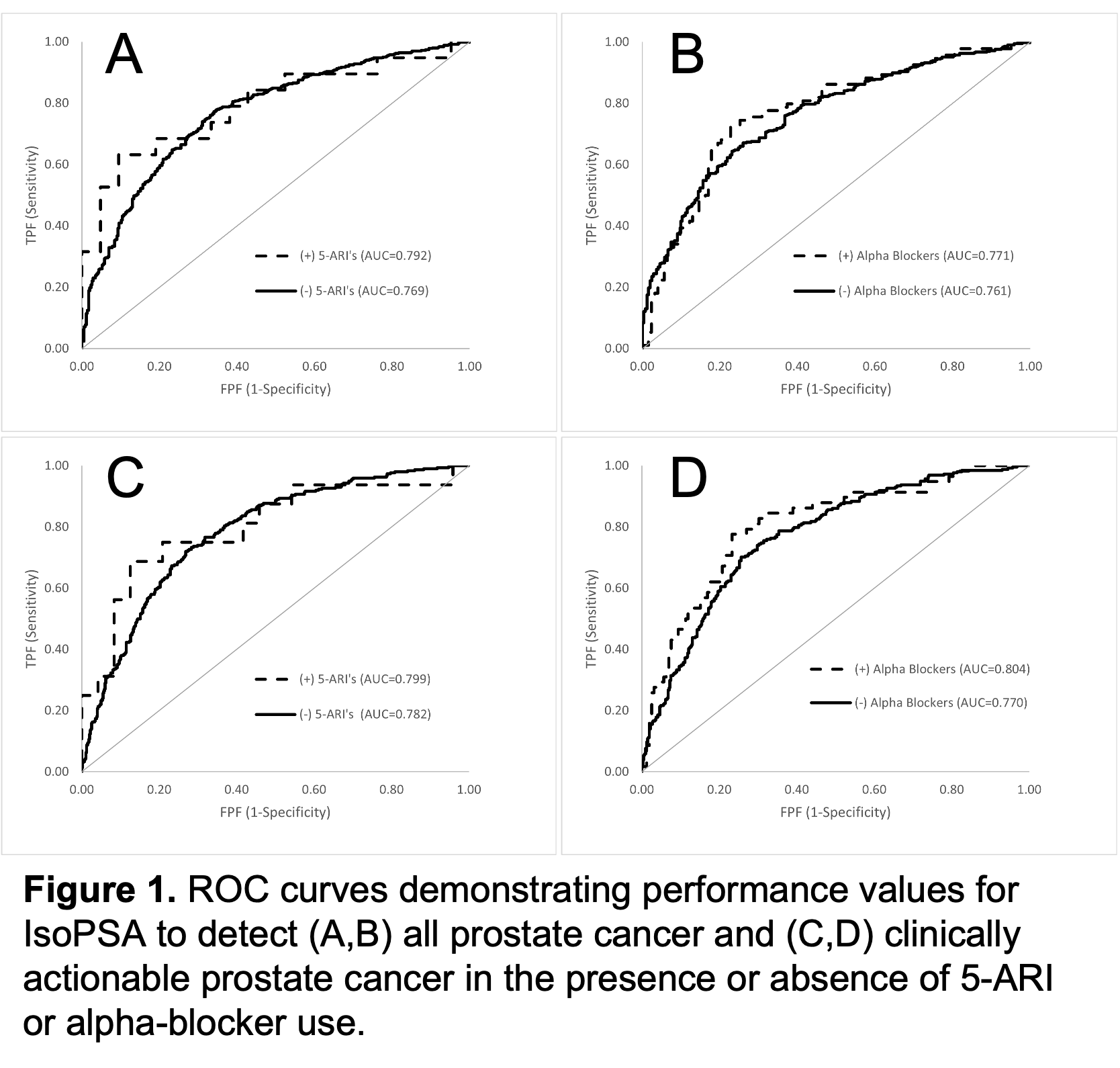
Introduction: IsoPSA is a structure-based test linked to tumor biology that has demonstrated improved performance characteristics over PSA and percent free PSA to identify clinically actionable prostate cancer (GG2+). Medications for benign prostatic hyperplasia (BPH) including 5-a reductase inhibitors (5ARIs) and a-blockers are commonly used in the patient population undergoing prostate cancer screening. The relationship between 5-ARIs and PSA levels is well established. We sought to determine the impact that common BPH medications have on IsoPSA performance. Methods: This is a secondary analysis of data from an institutional review board (IRB) approved, prospective, multicenter study evaluating IsoPSA in men =50 years of age with a total PSA = 4ng/ml with planned prostate biopsy who met previously described inclusion/exclusion criteria. Analytic groups included (i) all subjects, (ii-iii) +/- 5-ARI use, (iv-v) +/- a-blocker use. Sensitivity and specificity analysis were performed and receiver operating curves (ROC) were evaluated. Results: A total of 1,385 men were recruited from a multi-center (8 sites), prospective, nonrandomized cohort with 888 men included in final analysis. Actionable prostate cancer, defined as GG2 or greater, was identified in a total of 316 patients (35.6%). In this cohort, 40 patients reported 5-ARI use and 217 reported a-blocker use. At the pre-determined IsoPSA threshold (5.25 all cancer; 6.0 GG2+) sensitivity to detect both all prostate cancer and actionable cancer was similar between all patients enrolled and patients on either 5-ARIs or a-blockers (All: 0.90 vs 5-ARI: 0.94 vs a-blocker: 0.85; p > 0.05). Specificity was similar between patients regardless of 5-ARI (No 5-ARI: 0.46 vs 5-ARI: 0.45, p > 0.05). Increased specificity was noted in patients on a-blockers (No a-blocker: 0.40 vs a-blocker: 0.61, p < 0.05). There were no additional differences in FP, FN, FP, FN, LR (+/-), PPV, or NPV rates between all sub-cohorts. ROC analysis demonstrates excellent performance of IsoPSA regardless of 5-ARI or a-blocker use for both the detection of all prostate cancer and for actionable cancer (Fig 1). Conclusions: Common BPH medications (5-ARI and a-blockers) do not negatively impact IsoPSA performance characteristics for the detection of prostate cancer including clinically actionable prostate cancer. SOURCE OF Funding: Cleveland Diagnostics funded the initial study of IsoPSA

.jpg "Jason M. Scovell, MD, PhD photo")