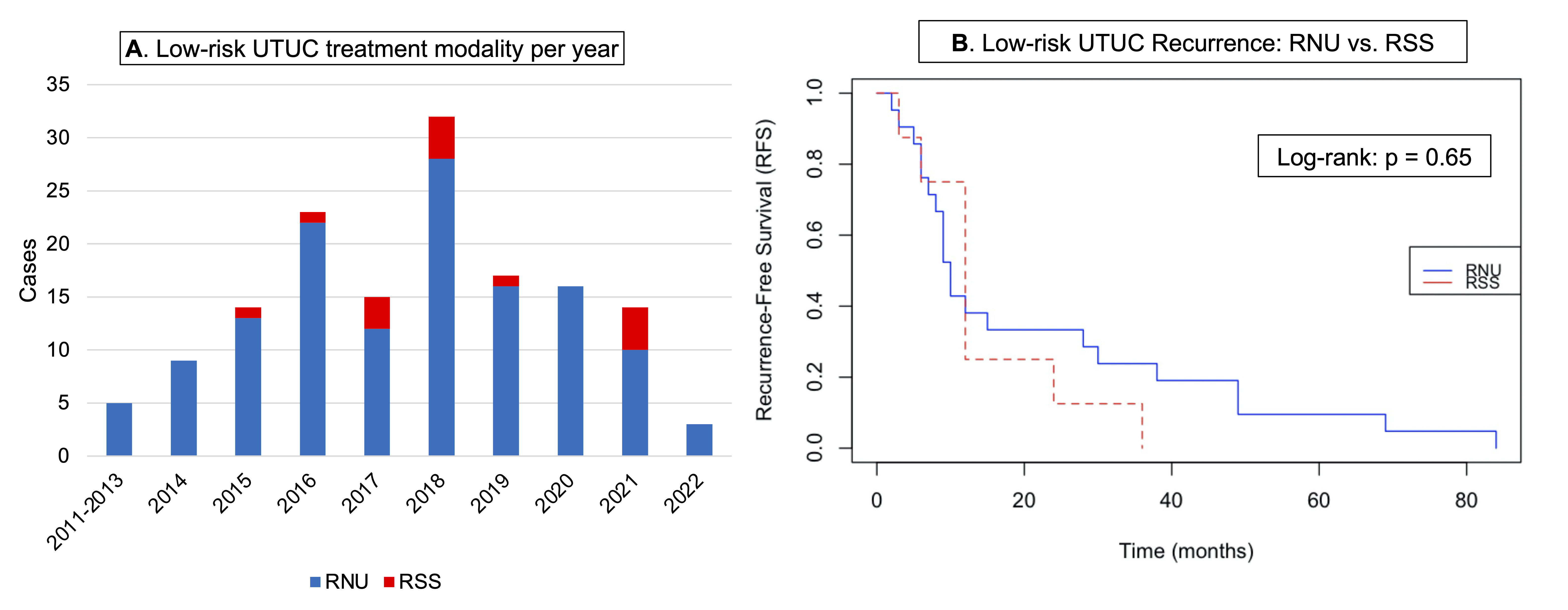
Introduction: Inaccurate preoperative staging is common in upper tract urothelial carcinoma (UTUC). It is useful to stratify low- and high-risk disease to appropriately select patients more likely to benefit from renal-sparing surgery (RSS) vs. radical nephroureterectomy (RNU). We provide an update of contemporary management of low-risk UTUC across high-volume centers and hypothesize that many low-risk cases are still frequently treated with RNU Methods: Patients were abstracted from an international cohort of 13 high-volume centers in the United States, Europe, and Asia (ROBUUST 2.0) undergoing treatment for UTUC from 2011-2022. We focused on patients with cN0M0 low-risk disease, as defined by: unifocal disease, tumor size < 2 cm, negative for high-grade cytology, low-grade on ureteroscopic biopsy, and no invasive aspect on preoperative CT. Clinical, pathologic, and recurrence data was collected. Descriptive statistics and Kaplan-Meier survival curves with log rank testing were performed. A trend analysis was completed to evaluate low-risk treatment modality by year Results: Of the 1596 cases, 148 patients met the criteria of low-risk. 90% were treated with RNU. Trend analysis showed a peak utilization of RNU for low-risk disease around years 2016-2018, with a decline in more recent years (Fig 1A). Mean age was 69.3 (11.9) years, with most males (62%), normal weight (BMI: 24.7±5.3), ECOG of 0 (66%), and no prior history of bladder cancer (91%). Mean follow-up time was 40 months, and 52% of patients were =pT1 on final pathology. 15.6% (21/134) experienced recurrence following treatment with RNU, with a mean time to recurrence 21.8 (23.2) months. 57% (8/14) experienced recurrence following RSS, with a mean time to recurrence of 14.6 (10.6) months (Fig 1B; log-rank p = 0.62). Most recurred within the bladder (90% in RNU, 50% in RSS) with the other recurrences occurring in the ipsilateral/contralateral upper urinary tract. No distant recurrences were recorded in RSS Conclusions: A significant majority of low-risk patients undergo RNU. While recurrence rate was higher in RSS (albeit non-statistically significant), none of these recurrences represented a distant metastasis. Our results should be considered within the framework of a retrospective design but provide insight to treatment patterns at high-volume centers SOURCE OF Funding: n/a