Session: MP40: Prostate Cancer: Detection & Screening I
MP40-15: The diagnostic value of PSMA PET/CT in men with newly diagnosed International Society of Urological Pathology grade group 3 intermediate-risk prostate cancer
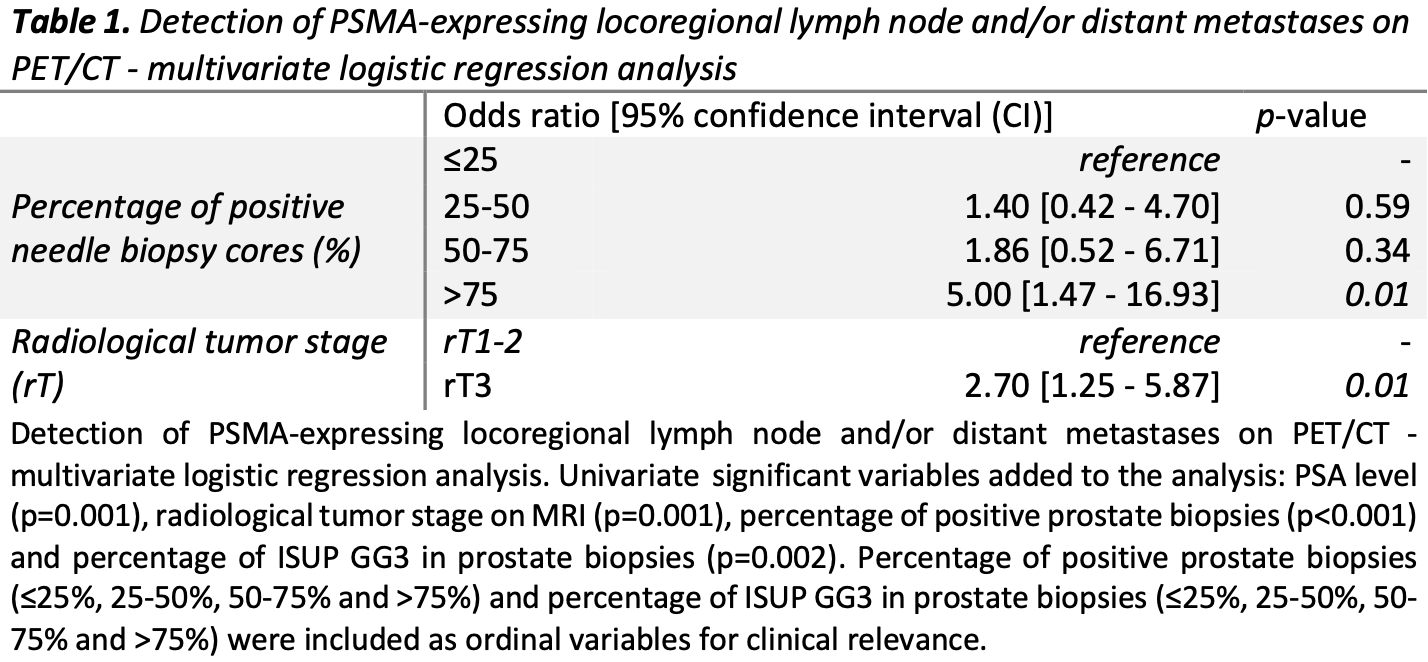
Introduction: Metastatic screening using prostate-specific membrane antigen (PSMA) positron emission tomography/computed tomography (PET/CT) is increasingly being adopted in urological practice. PSMA PET/CT has been shown to be of diagnostic value in men with high-risk prostate cancer (PCa), however, this has still not been demonstrated for men with International Society of Urological Pathology (ISUP) grade group (GG) 3 intermediate-risk PCa. This study aims to determine the diagnostic value of PSMA PET/CT within this subgroup of newly diagnosed ISUP GG3 intermediate-risk PCa patients. Methods: Patients with newly diagnosed ISUP GG3 intermediate-risk PCa, in whom a PSMA PET/CT was performed as a primary staging modality, were retrospectively studied. PSMA PET/CT scans were performed in several diagnostic centers and revised/reported by expert nuclear medicine physicians within two high-volume PCa centers by expert nuclear medicine physicians. A multivariate logistic regression analysis, taking into account clinical, biochemical, pathological and radiological variables, was performed to identify potential independent predictors for metastatic disease on PSMA-PET/CT. Results: In total, 396 men with newly diagnosed ISUP GG3 intermediate-risk PCa were studied. Metastatic disease was observed in 37/396 (9.3%) men, of whom 29/396 (7.3%) had molecular imaging locoregional lymph node metastases (miN1) and 16/396 (4.0%) had distant metastases (miM1). A radiological tumor stage =T3 on MRI (OR: 2.70 [95% CI: 1.25-5.87], p=0.01) and more than 75% positive prostate biopsies (OR: 5.00 [95% CI: 1.47-16.93], p=0.01) were found to be independently associated with metastatic disease on PSMA PET/CT (Table 1). Conclusions: Given that metastatic disease was observed in nearly one in ten men with biopsy ISUP GG3 intermediate-risk PCa, PSMA PET/CT is considered to be of diagnostic value within this population. Further stratification using the radiological tumor stage and the percentage of positive prostate biopsies could aid in identifying those patients at risk of having metastatic disease on PSMA PET/CT. SOURCE OF Funding: No funding was obtained.