The Arthur Smith Institute for Urology, Northwell Health
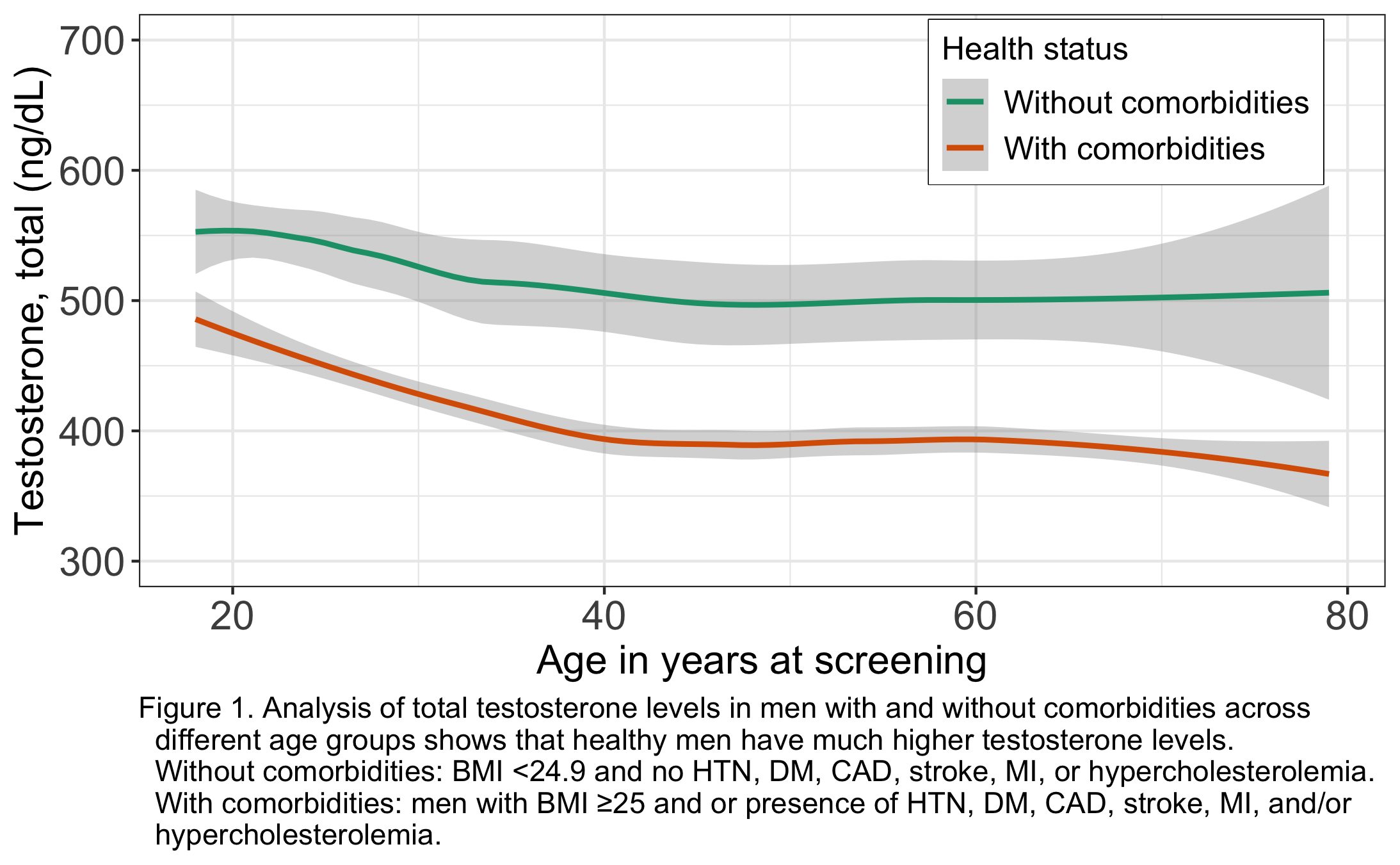
Introduction: The arbitrary cut-off total testosterone (TT) level of 300 ng/dL is used to diagnose hypogonadism in men of all ages, although intuitively, younger men should have higher TT levels. There is growing evidence that TT level is a proxy of men’s overall health. This study aimed to analyze the effects of age, common comorbidities, and body mass index (BMI) on TT. Methods: Data from the 2013-2016 NHANES survey were analyzed. TT was measured using liquid chromatography-mass spectrometry certified by the CDC. Only men 18-79 years old were evaluated in the study. Men taking testosterone and aromatase inhibitors were excluded. We conducted a multivariate analysis of the following risk factors for low TT: age, BMI, diabetes mellitus (DM), hypertension (HTN), hypercholesterolemia, and coronary artery disease (CAD). DM was defined as HgA1c = 6.5% or diagnosis by a physician, and hypercholesterolemia as cholesterol above 240 mg/dL or diagnosis by a physician. Healthy men were defined as men with BMI <24.9 without any of the above risk factors. Linear and local polynomial regression models were used for fitting TT. The t-test was used to compare mean TT between groups. Statistical significance (SS) was set at p<0.05. Results: The study consisted of 4,615 men with a median age of 46 years. Multivariate analysis showed that hypercholesterolemia (p < 0.001), DM (p=0.03), and elevated BMI (p < 0.001) were predictors of low TT. Neither age nor HTN was SS for TT in the multivariate analysis. With age, TT level slightly decreased, especially from 18 to 34. There were twice as many hypogonadal (TT < 300 ng/dL) men at the age of 34 than at the age of 18 (25% v 12.5%; p<0.001). The overall mean TT level for healthy men was higher at 522 ng/dL (95%CI: 506-538) than unhealthy men at 390 ng/dL (95%CI: 382-398) (p < 0.001) (Fig 1). Mean values of TT in both healthy men and men with comorbidities are higher than the cutoff value of 300 ng/dL. Conclusions: Obesity, even being overweight, and poor cardiovascular health, but not age, are strongly associated with lower TT. Healthy men, regardless of age, typically have TT levels above 500 ng/dL. Our study suggests that weight loss, controlling DM and cardiovascular risk factors likely increase TT, and such interventions should be discussed with patients in addition to testosterone therapy. SOURCE OF Funding: Fracchia Research Scholarship