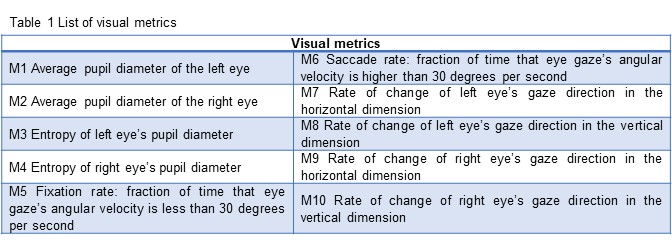
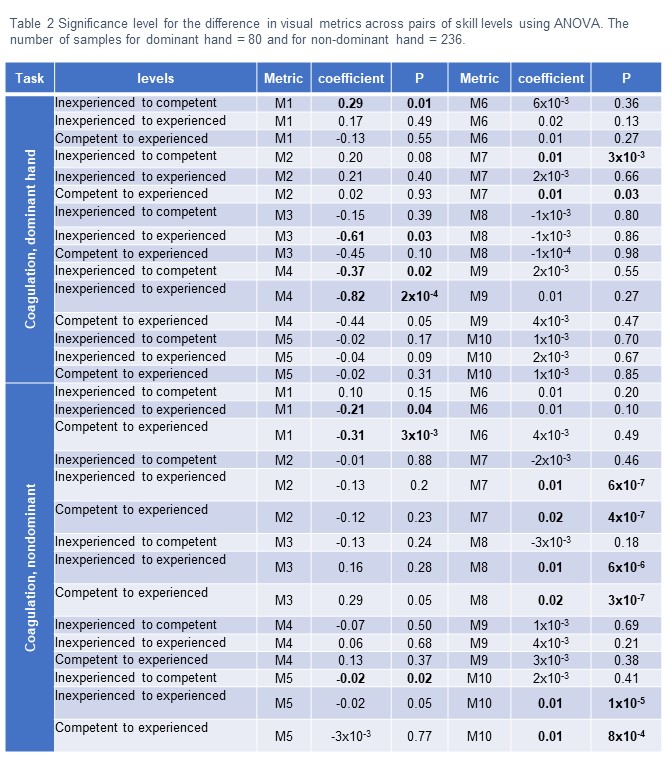
Introduction: An objective method for assessing robot-assisted surgery (RAS) skills that can be used in clinical settings has not been established. This study aimed to compare visual metrics at three different skill levels—inexperienced, competent, or experienced— to determine whether eye gaze data differed among RAS surgeons. Methods: Eleven right-handed participants who performed coagulation subtasks (monopolar or bipolar cautery) during hysterectomy, cystectomy, or nephrectomy on live pigs with the Da Vinci robot had their eye gaze data captured using TobiiPro2 eyeglasses. Visual metrics were extracted using eye gaze data (Table 1). An expert RAS surgeon evaluated each participant's performance and level of expertise after watching operation videos using the modified Global Evaluative Assessment of Robotic Skills (GEARS) assessment tool. Each metric was compared across the three skill levels—novice, competent, or experienced—using ANOVA. Results: When participants performed coagulation using the dominant hand, the entropy of the right eye’s pupil diameter differed among skill levels (p-value = 0.01). When this subtask was completed with the non-dominant hand, the rates of change of the gaze directions of the left eye in the horizontal and vertical dimensions and the right eye in the vertical dimension differed (p-values = 2x10⁻⁶, 6x10⁻⁶, and 6x10⁻⁴, respectively) across skill levels. Table 2 shows the significance level for the difference in visual metrics between skill level pairs. Conclusions: Visual metrics differed significantly across RAS skill levels. The ease and efficacy of recording and evaluating visual data without interfering with the surgeon's work suggest a new objective surgical skill evaluation method that could be applied to clinical settings. SOURCE OF Funding: National Institute of Biomedical Imaging and Bioengineering of the National Institutes of Health under award number R01EB029398, the Alliance Foundation of Roswell Park Comprehensive Cancer Center, and the National Cancer Institute (NCI) grant P30CA016056 involving the use of Roswell Park Comprehensive Cancer Center’s Laboratory Animal Shared Resource and Applied Technology Laboratory for Advanced Surgery.