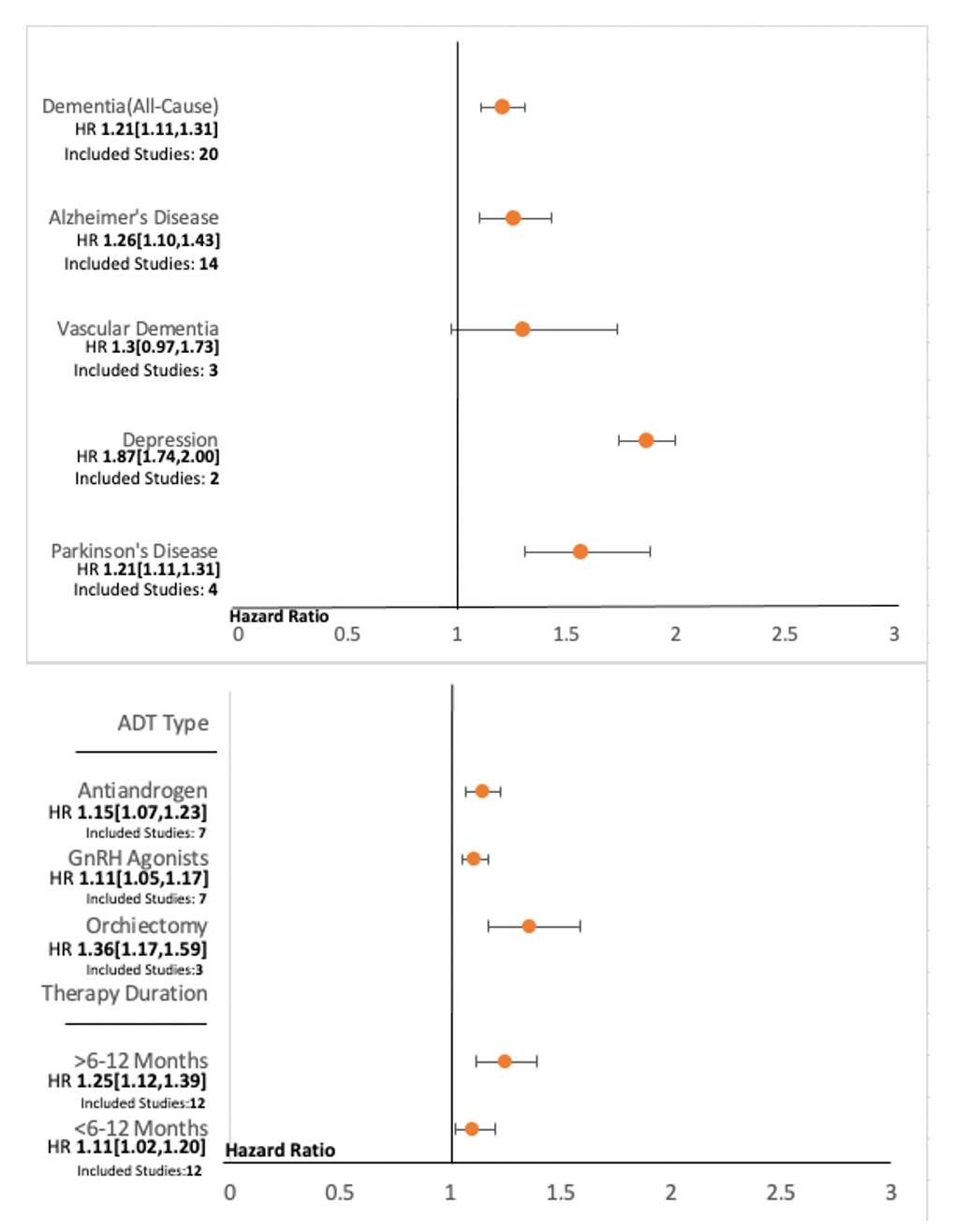
Introduction: Androgen Deprivation Therapy (ADT) is used to treat select localized prostate cancer, biochemical recurrence and overt metastatic cancer. Androgens play a role in maintaining synaptic density, neuronal plasticity and beta-amyloid degradation. Cognitive decline and dementia due to ADT have been proposed as possible long-term consequences. This study aims to analyze the currently available evidence for the risk of dementia and other neurocognitive disorders in patients receiving ADT. Methods: In February 2022, a systematic search was performed according to PRISMA guidelines, querying databases for “Androgen Deprivation Therapy”, “Prostate Cancer”, AND “Dementia”, “Alzheimer’s disease”(AD), and “vascular dementia”(VD). Data was analyzed in Review Manager V 5.4.2(Cochrane). Heterogeneity was assessed using Higgins I2%. Results: A total of 22 studies were included, which provided 2,413,131 patients, of which 846,394 had prostate cancer and received ADT. Our analysis found an increased risk of dementia (all-cause) (HR 1.21[1.11,1.31] p<0.00001), AD (HR 1.26[1.10,1.43], p=0.0007, depression (HR 1.87 [1.74,2.00], p<0.00001), and Parkinson’s disease (HR 1.57[1.31,1.88], p<0.00001). Risk for vascular dementia was increased but not statistically significant (HR 1.30 [0.97,1.73], p=0.08). Subgroup performed by type of ADT demonstrated an increased risk of dementia for orchiectomy (HR1.36 [1.17,1.59] p < 0.0001), antiandrogens (HR 1.15 [1.07,1.23] p<0.0001) and GnRH Agonists (HR 1.11 [ 1.05,1.17] p = 0.0002). Subgroup analysis by treatment duration demonstrated an increased risk of dementia regardless of duration. Conclusions: Meta-analysis of the currently available clinical literature demonstrates that ADT for prostate cancer is associated with a significantly increased risk of dementia, AD, PD, and depression. Further studies are needed to better characterize the interaction of ADT, aging and the underlying prostatic malignancy. SOURCE OF Funding: No funding was received.