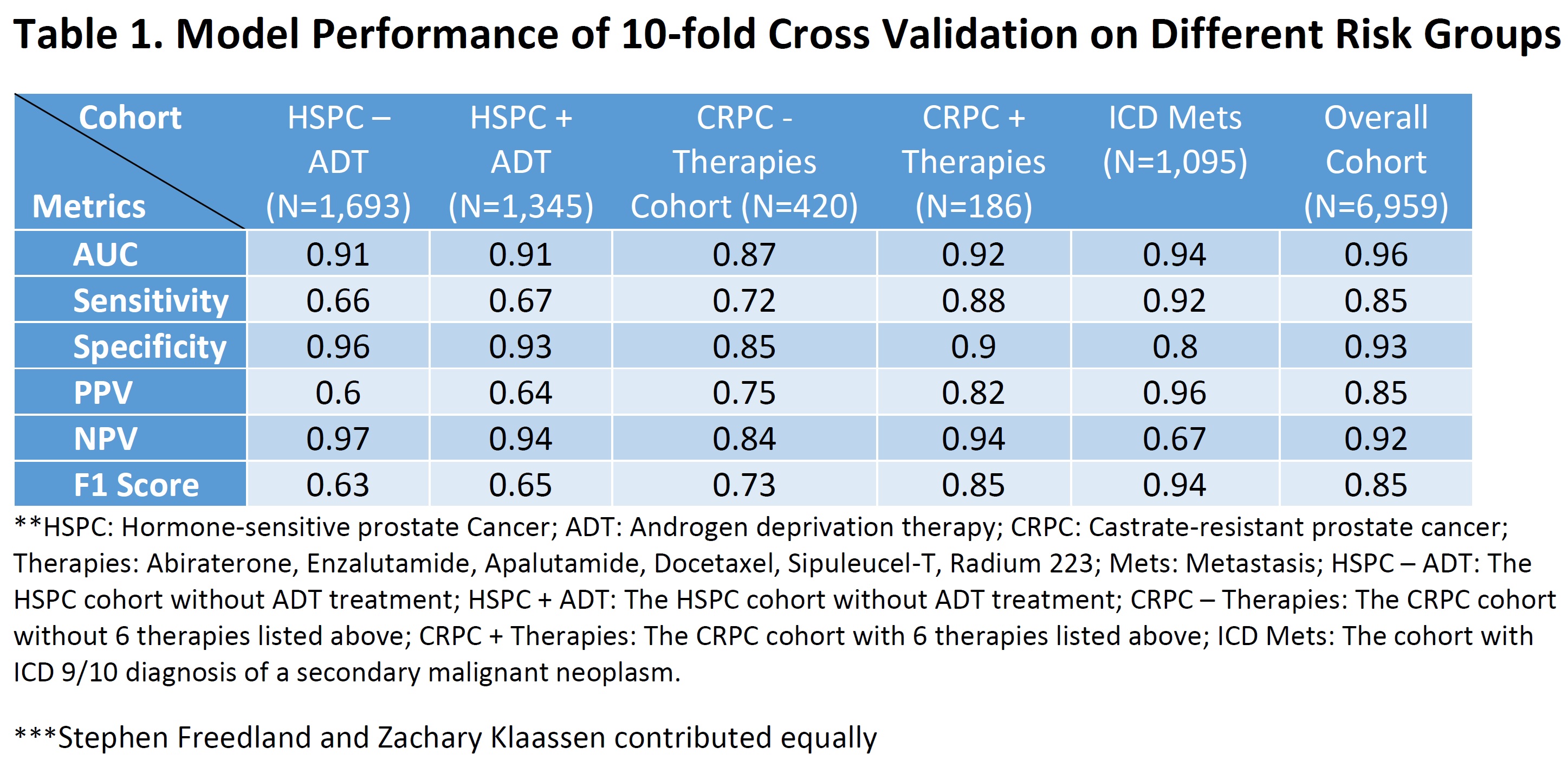
Introduction: Prostate Cancer (PCa) is typically associated with metastases to bone and/or soft-tissue. Many studies have observed a survival benefit in timely identification of metastatic prostate cancer (mPCa). We and others have recently published natural language processing (NLP) tools to identify metastatic disease. We aimed to build upon our prior work to develop a FastText based supervised learning model for rapid mPCa identification through text data of individual scans. Methods: We collected 128,092 scans on 6,959 unique patients from the U.S. Veterans Affairs Health System. We built a supervised learning model based on FastText word embedding and evaluated its performance for different patient risk groups , and where ICD codes for metastasis, CRPC, receipt of certain drugs and ADT were taken into consideration. We finally reported the statistical results of 10-fold cross validation against hand-abstracted (i.e. “true”) metastasis status. Results: Overall, among 6,959 patients, the model had an avg AUC of 0.96 (averaged over 10-fold cross validation), with high sensitivity and specificity for predicting a positive result (85% and 93%, respectively) when 0.5 cut-point was selected. PPV was 85%, NPV was 92% and F1 score was 0.85. For different risk-groups (N=4,739), the model had high AUCs ranged from 0.91 to 0.94 depending on the clinical characteristics of the cohorts used in the validation. The avg model training time for the training set (115k notes on 6.3k patients) was < 5 mins and the avg identification time for validation set (13k notes on 700 patients) notes was only 1s. Conclusions: This study systematically investigated the programmatic identification of mPCa in a large cohort using word embedding and supervised learning and evaluated the model performance in different risk groups. Overall, the model had extremely high accuracy and higher than our previously published model. In addition, our method is extremely fast either for model training or final identification. Thus, this study provides a practical tool for rapid and accurately identifying patients with metastases in the VA system, an essential step forward in population-based research. SOURCE OF Funding: Merck