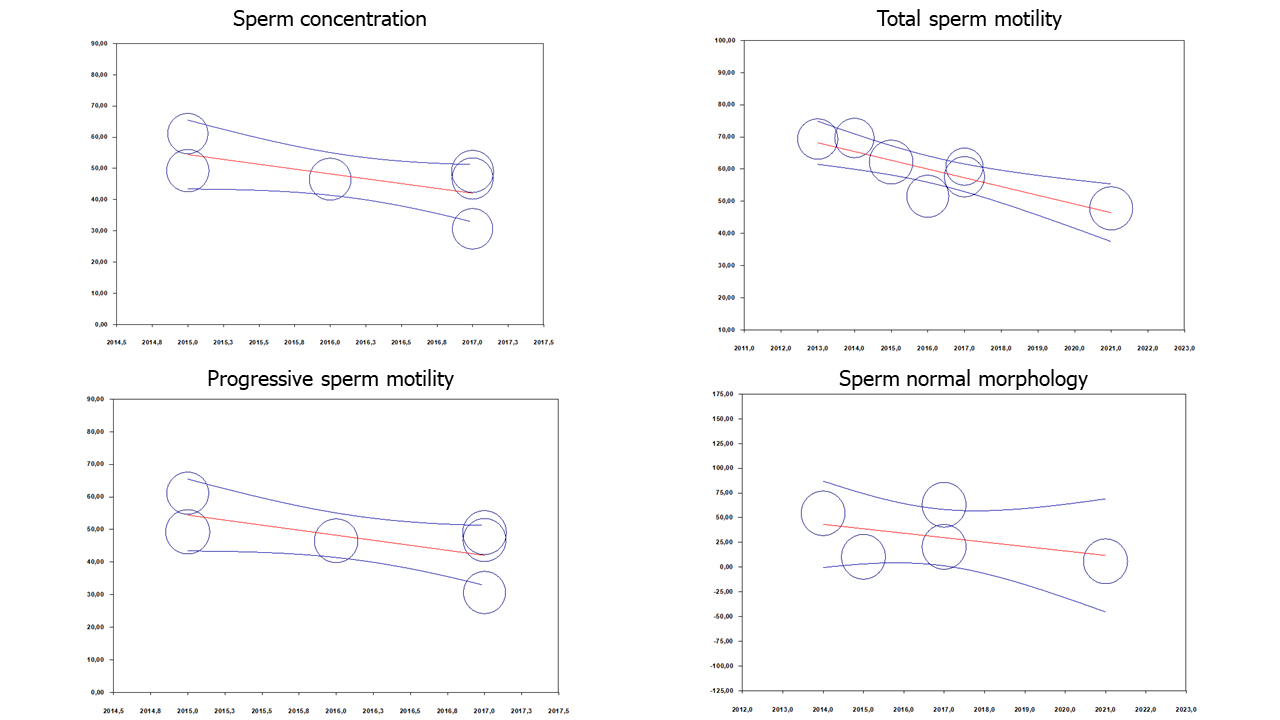
Introduction: While current evidence suggests the existence of a downward trend of sperm concentration and count in unselected men from both industrialized and underdeveloped countries, these data have been controversial due to the heterogeneity of the study populations and the differences in World Organization Health (WHO) manual edition used. In response, we performed a focused meta-analysis specifically in men with proven paternity and restricted our analysis to studies using the 5th edition of the WHO manual (2011-2020). Methods: A literature search was performed using Scopus, PubMed, Ovid, Embase and Cochrane databases according to PRISMA guidelines. Men were defined as fertile if demonstrating proven paternity with variable interval between conception and semen analysis. The primary outcomes of this study was sperm concentration, and the secondary outcomes included semen volume, progressive motility, total sperm count, and morphology. A meta-regression analysis was performed to determine the change in the selected outcomes over time. Results: 4286 abstracts were initially reviewed, 139 full text articles were fully assessed for eligibility, and a total of 8 articles were included in the final cohort. Sperm concentration (mean 86.2M/ml, 95% CI 49.0, 123.4, I2= 99.1%; p<0.001) did not change from 2011 to 2020 (p= 0.4105). Only three studies reported total sperm count (322.7M/ejaculate, 95% CI 52.2, 593.2, I2= 99.9%; p<0.001), and the data were insufficient to run a meta-regression analysis. Semen volume (3.6 ml, 95% CI 2.5, 4.7, I2= 99.3%; p<0.001) did increase from 2011 to 2020 (+0.303 mL/year; p<0.01). Interestingly, both sperm motility (59.7%, 95% CI 53.5, 66.0, I2= 97.8%; p<0.001) and progressive motility (48.5 %, 95% CI 47.6, 49.3, I2= 95.4%; p<0.001) significantly reduced over the study time period (-2.2%/year, p<0.0001 and -3.1%/year, p<0.01). Sperm morphology (71.8 %, 95% CI 71.0, 71.6, I2= 99.7%; p<0.001) and vitality (30.4 %, 95% CI 19.6, 41.2, I2= 97.1%; p<0.001) did not change from 2011 to 2020. Conclusions: The results of this study suggest that sperm motility, but not total count, may be falling for unknown reasons. Further work is needed to better understand the mechanisms and clinical implications for this finding. SOURCE OF Funding: None