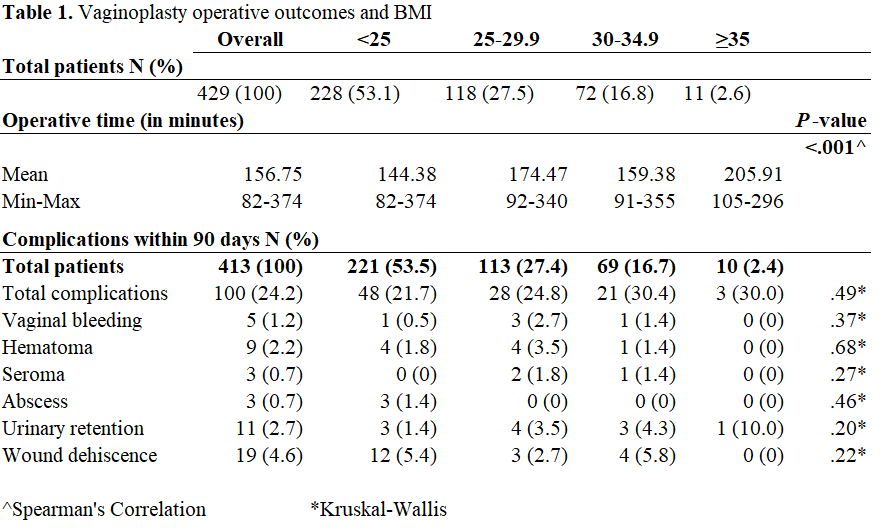
Introduction: Body mass index (BMI) is used in gender-affirming vaginoplasty to inform decision-making for surgical candidacy. To contribute to the limited body of evidence, we report our center’s outcomes specific to BMI. Methods: We conducted a retrospective review of patients undergoing primary robotic peritoneal flap vaginoplasty with the senior authors from 9/2017-7/2022. We reviewed BMI recorded on surgery day and at consultation. We included complications occurring within 90 days of surgery. We analyzed dilation outcomes for patients with at least one year of follow-up. Nonparametric statistical tests were used for analysis. Results: 429 patients underwent surgery with the senior authors. 413 patients had 90 days of follow up, and 245 patients had one year of follow-up. Most patients (80.9%) with 90 days of follow-up had a BMI <30 kg/m2. 19.1% had a BMI =30 kg/m2. BMI appears to affect operative time (P= <.001). We found no statistically significant associations between BMI and any type of complication. 57.1% of patients had at least one year of follow-up, and among these patients, there was no statistically significant difference between BMI groups and dilation outcomes. Conclusions: BMI =35 kg/m2 appears to increase operative time for gender-affirming vaginoplasty. Within our patient population, BMI does not have a statistically significant relationship with complications and dilation outcomes. There still exists limited data for patients with BMI =35kg/m2 and further research is needed on how BMI factors into decision-making for surgical candidacy. SOURCE OF Funding: None.