PD13-04: Development of a Novel Gene Expression Scoring System for Recurrence in Non-muscle-invasive Bladder Cancer after Transurethral Resection of Bladder Tumor
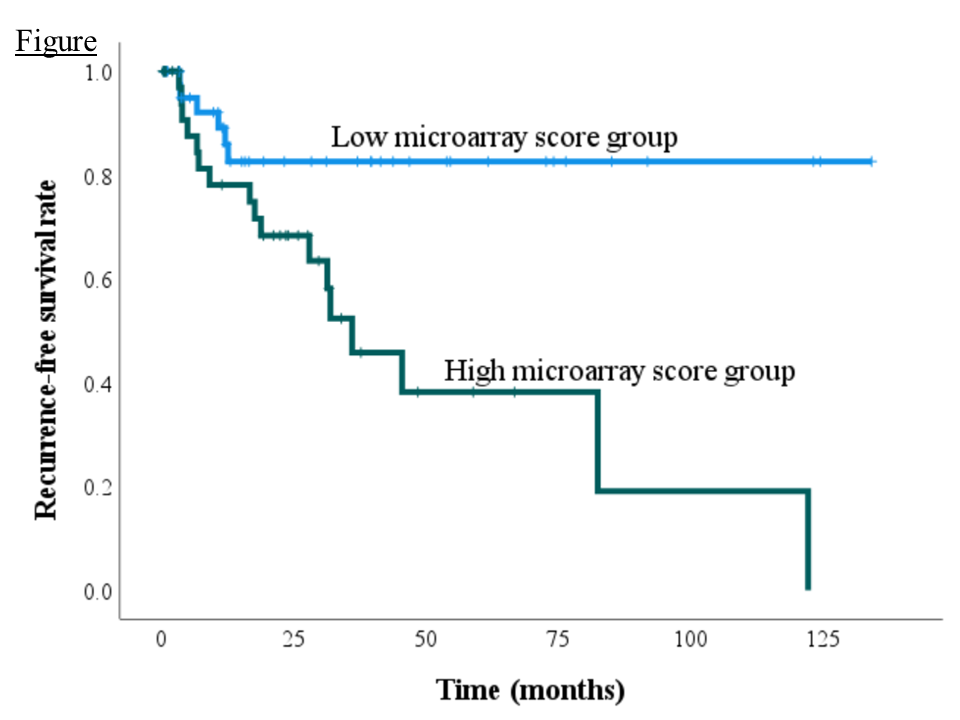
Introduction: Non-muscle-invasive bladder cancer (NMIBC) frequently recurs after transurethral resection of bladder tumor (TURBT). However, clinical prognostic factors do not always accurately predict tumor recurrence. Therefore, we developed a new gene expression scoring system that is practical for distinguishing between high- and low-risk NMIBC that recur after TURBT. Methods: We included 89 patients (median age 75) diagnosed with NMIBC after initial TURBT without prior or concurrent upper tract urothelial carcinoma at our institution between 2008 and 2019. This study obtained the approval of the institutional ethics board and the patient's consent. Variations in the expression signature of 14,400 genes within each patient were measured by our microarray analysis which has no mRNA amplification bias, not requiring validation by quantitative reverse transcriptase PCR. A hierarchical cluster analysis was performed to identify a set of genes that discriminates between high- and low-risk NMIBC. Results: Eleven genes were extracted that predict tumor recurrence after TURBT. The cumulative equivalent of the 11 genes (microarray score) was obtained from each sample, and the optimal cutoff score was calculated to be 1.29 (area under the curve 0.83). A Kaplan-Meier curve showed the 5-year recurrence-free survival (RFS) rate was 38.2% in the “high microarray score group” (microarray score =1.29, n=39), which was significantly lower than in the “low microarray score group” (82.6%, p=0.002, Figure). The 5-year RFS rate in patients with single, Ta low grade tumor < 3 cm in diameter without CIS (n=15) was 90.0%, which was higher than in the rest (55.2%); however, no significant difference was observed (p=0.063). Multivariate Cox regression analysis showed that a microarray score =1.29 was an independent factor for disease recurrence (hazard ratio 3.89, p=0.005), but clinical factors were not. Conclusions: Our novel gene expression scoring system proved to be more useful in predicting recurrence in patients with NMIBC after TURBT than clinical prognostic factors. This scoring system may enable individualized strategic management of high-risk NMIBC patients. SOURCE OF Funding: None.