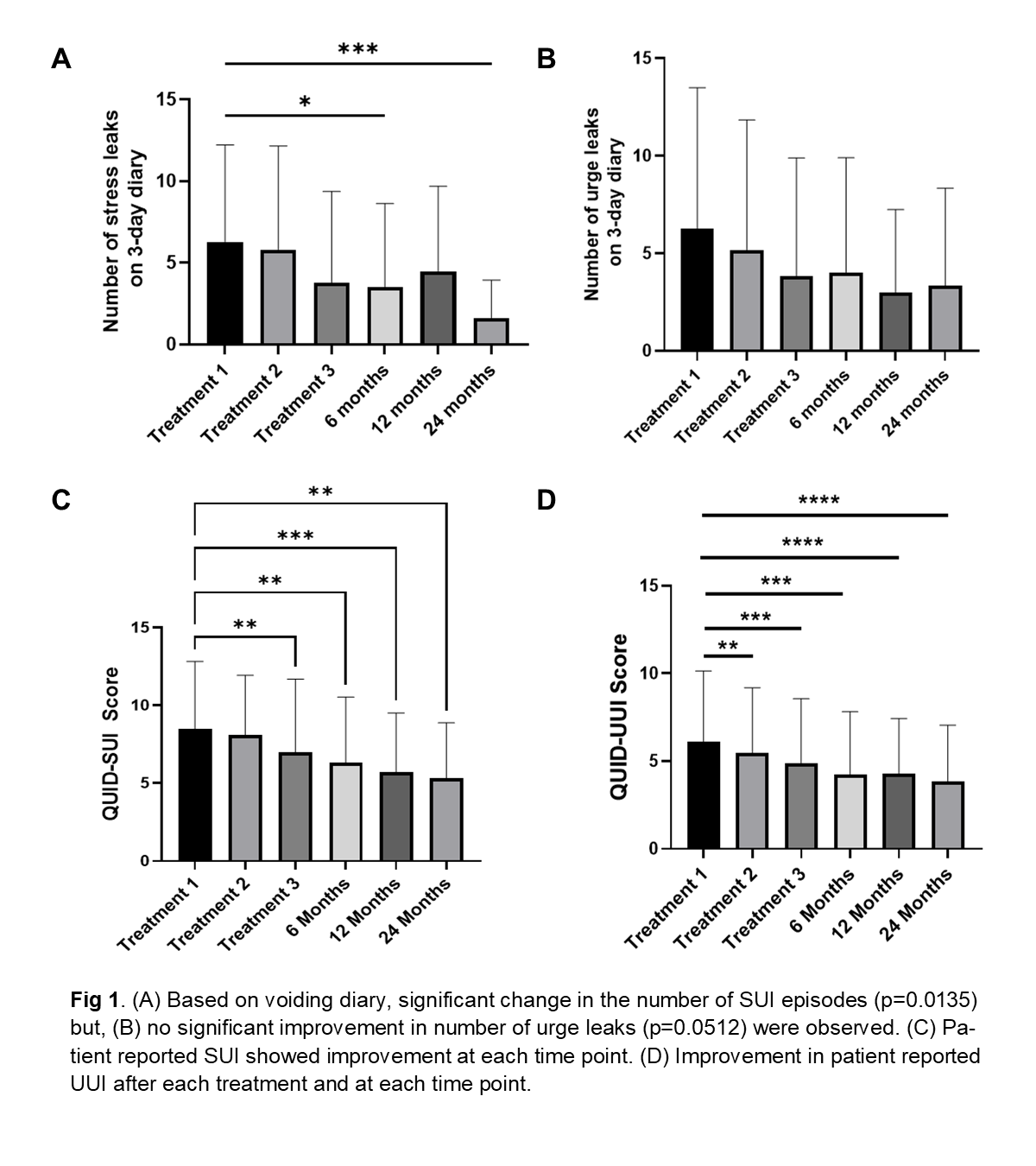
Introduction: Fractional carbon dioxide laser (fCO2) has been proposed to treat frequency, urgency, urge urinary incontinence (UUI), and stress urinary incontinence (SUI) in genitourinary symptoms of menopause (GSM). The laser’s thermal effects help collagen remodeling, thereby improving vaginal tissue integrity and urethral support. Our aim was to prospectively measure the effect of vaginal fCO2 laser therapy on SUI and overactive bladder (OAB) symptoms at 24 months. Methods: Women over 18 years with urogenital symptoms were enrolled in an open-label prospective trial. Participants underwent 3 laser treatments, each 6 weeks apart. Patients were required to be off vaginal estrogen for 3 months prior to receiving any treatments. Patients were offered additional annual treatment sessions. Follow up consisted of 6, 12-, 18-, and 24-month visits during which various questionnaires were administered including the Incontinence-Quality of Life (I-QOL), Overactive Bladder Questionnaire short form (OABq-SF), and Questionnaire for Urinary Incontinence Diagnosis (QUID). A voiding diary was collected at baseline, 6-, 12-, and 24- month visits. ANOVA analysis was used to compare means at each time point. Results: 100 patients were enrolled at time of analysis. Baseline urinary symptoms consisted of 44.8% of patients with SUI, 57.1% with UUI, and 75.4% with frequency. Significant reduction in SUI episodes was observed at 6, and 24 months (p=0.0135; Fig 1), and participants noted improvement on QUID-SUI at 6, 12, and 24 months (p < 0.0001). Number of urge leaks did not significantly improve on voiding diary (=0.0512), but significant subjective improvement was noted for OAB/UUI based on QUID-UUI and OABq-SF symptom scores at each time point (p < 0.0001; Fig 1). Mean Patient Global Impression of Improvement scores improved at each treatment and follow up visit, with 46.4% reporting significant symptom improvement by 24 months. Participants had improvement between baseline and 24 months in vulvar dryness (50.9% vs 25%) and vulvar pain (48% vs 13%). Conclusions: This represents the longest prospective follow-up of laser effects on GSM associated urinary symptoms. Significant subjective improvement was noted for SUI and OAB/UUI up to 24 months after treatment. SOURCE OF Funding: None