Assistant Professor of Surgery Harvard Medical School
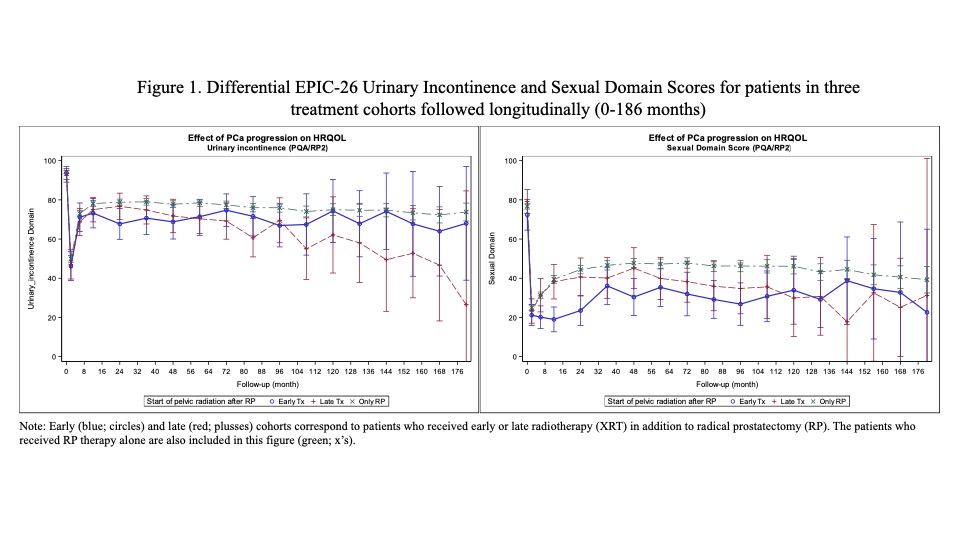
Introduction: The optimal timing of radiotherapy (XRT) after radical prostatectomy (RP) is controversial, and the impact of early versus late post-RP XRT on patient-reported health related quality of life (HRQOL) is unclear. Methods: In our PROST-QA (2003-2006) and RP2 (2010-2014) consortium studies, 1203 men with localized prostate cancer were treated with RP; of those, 121 men received post-RP XRT. All subjects were prospectively enrolled and underwent longitudinal clinical follow-up and third-party HRQOL evaluation. The exposure of interest was receipt and timing of post-RP XRT, leading to three treatment groups: 1) RP only (n=1,082), 2) RP + early XRT (n=57), and 3) RP + late XRT (n=64). Early versus late XRT was defined as =12 months and >12 months post-RP, respectively. The primary outcome was HRQOL via the Expanded Prostate Cancer Index Composite (EPIC-26) sexual, urinary incontinence and urinary irritation/obstruction scores, measured at pre-treatment and annually thereafter. Treatment groups were compared using multivariable generalized estimating equations (GEE) models of change in longitudinal HRQOL domain scores. Urinary incontinence pad usage was also evaluated before and after post-RP XRT. Results: Median follow-up for the entire cohort was 85.6 months (IQR 35.8-117.2). Compared to RP alone, subjects undergoing post-RP XRT had significantly worse longitudinal changes in sexual, urinary incontinence and urinary irritation/obstruction HRQOL (p-values: 0.03, 0.004, <0.001, respectively). We were unable to detect HRQOL differences between late and early XRT longitudinally, due possibly to the size of the XRT cohorts (n=121 total). Longitudinal differences between the three groups are demonstrated in Figure 1. Continued post-RP recovery for urinary control was noted after early XRT, as 49% of subjects were pad-free before XRT, and 70% were pad free at their next HRQOL evaluations. Conclusions: This prospective cohort study with long-term follow up confirms the detrimental impact of XRT on post-RP HRQOL. Distinguishing differences between late and early XRT after RP was not detectible, limited by the size of our post-RP XRT cohorts. Further study is needed to assess the differential impact of treatments and prostate cancer recurrence/progression on HRQOL. SOURCE OF Funding: NCT01325506: Effectiveness of Open and Robotic Prostatectomy (PROSTQA- RP2); 5RC1EB011001-02 Effectiveness of Robotic Compared to Standard Prostatectomy for Prostate Cancer