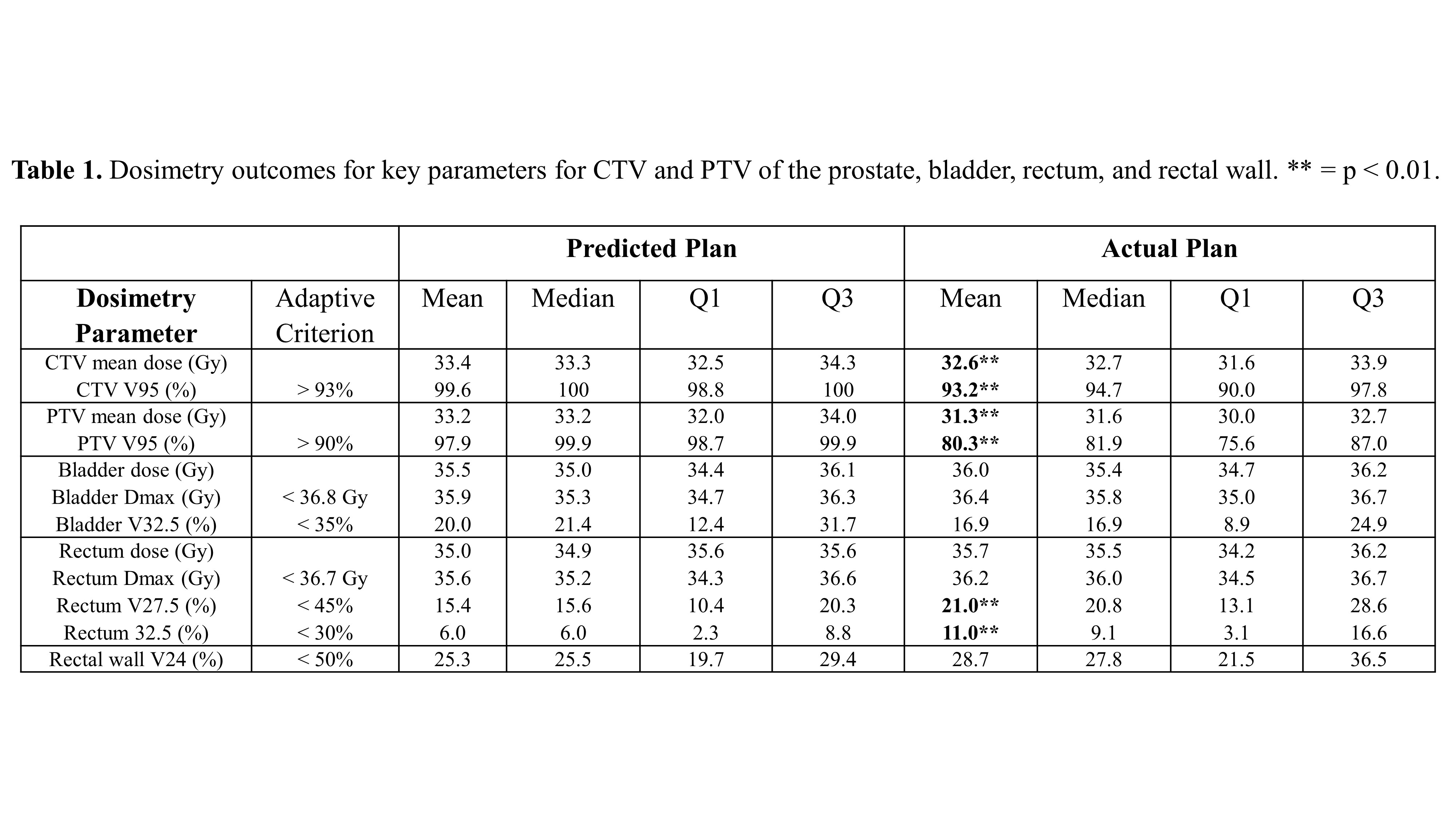
Introduction: One major challenge of postoperative radiotherapy is the deformable nature of the bladder and rectum. These changes can potentially lead to underdosing of the prostate bed and overdosing of the organs at risk (OARs: bladder and rectum). Our objective was to quantify the dosimetric impact of interfractional prostate bed and OAR deformation. Methods: SCIMITAR (NCT03541850) was a prospective phase II clinical trial evaluating stereotactic body radiotherapy (SBRT) for post-prostatectomy patients. This analysis included men receiving CT-guided SBRT. All patients received five fractions of 6-6.8 Gy to the prostate bed. The clinical target volume (CTV) and OARs were retrospectively contoured on fractional CBCT images using MIMVista. Volumetric, shape (via the dice similarity coefficient [DSC]) and dosimetric changes were quantified. Student’s t-test was used to analyze the differences between planning and daily treatment outcomes Results: 31 patients were eligible for this analysis. We found the CTV volume remained stable (median change 1.1%; IQR: -15.1% – 16.1%), while the shape was highly deformable (DSC of 0.76 [IQR: 0.71 – 0.79]). The bladder and rectum exhibited similar changes with median volume change of 5.7% (IQR: -24.3% – 51.0%) and 5.5% (IQR: -8.7% - 21.9%) respectively and median DSC of 0.77 (IQR: 0.68 – 0.84) and 0.74 (IQR: 0.69 – 0.80) respectively. Notably, the CTV received less radiation than planned (volume receiving 95% of dose 93.2% vs 99.6%, p < 0.01). Additionally, 39% (56/145) of total fractions and 52% (15/29) of patients met criteria for under coverage (volume receiving 95% of the dose < 93%). The rectum received more radiation than planned on several dosimetric parameters (volume receiving 27.5 Gy increased from 15.4% to 21.0% [p = 0.009] and volume receiving 32.5 Gy increased from 6.0% to 10.9% [p = 0.006]) (Table 1). Conclusions: We found underdosing of the prostate CTV and overdosing of the rectum in a fair percentage of patients receiving postoperative radiation, despite modern radiotherapy planning and delivery techniques. While future work will correlate these dosimetric consequences with toxicity and efficacy, these data suggest that approaches to improving dose delivery, such as adaptive radiotherapy, may be beneficial. SOURCE OF Funding: AUA Medical Student Fellowship

.jpg "Tommy Jiang, BA photo")