Sidney Kimmel Medical College of Thomas Jefferson University
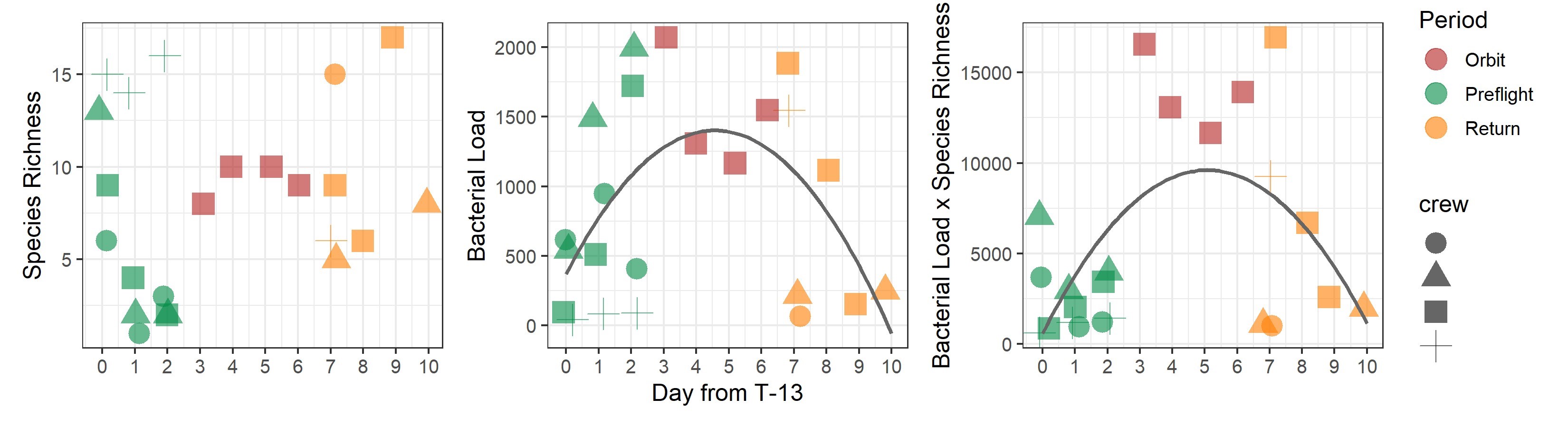
Introduction: Space travel exposes crew to substantial stressors, which may potentially alter their microbiome. It is important to understand whether the urinary microbiota is altered to protect the health and safety of travelers and professional astronauts. We hypothesize that the urinary microbiota is altered during a short-duration space flight to the International Space Station (ISS). Methods: IRB approval was obtained to collect urine samples from four crew members on a short-duration space flight to the ISS. One crew member (Crew#1) provided condom-catheter Orbital urine samples on the ISS (O+2, 4, 6, 8 days). Crew#1 also provided paired mid-stream and condom catheter urine collections for direct comparison of collection method Pre-launch (T-minus 13, 7, 1 days) and 2 days after Return to Earth. Three additional crew provided Pre-launch and Return mid-stream urines samples only. Urine was stored at -80 degrees Celsius and sent for 16s next-generation sequencing (MicroGenDX, Lubbock, TX, USA). Results: Bacterial load did not vary by urine collection method (p=0.42) or time (p=0.93). Species richness and differences in microbiota composition (Bray-Curtis Dissimilarities) did not vary by collection method (p=1.0 and 0.63), but did vary by time (p=0.01, F=26.2, d.f.=3,7, R2=0.96 and p=0.04, F=2.79, d.f.=3,7). Significant differences in microbial composition among Pre-flight, Orbital, and Return groups for Crew#1 were detected (p=0.001, F=3.16, d.f.=2,9, R2=0.47). Post-hoc testing revealed that Preflight and Orbital samples notably differed (p=0.06), Orbital and Return samples significantly differed (p = 0.03), and Preflight and Return samples did not significantly differ (p=0.2). The effect of grouping on the product of bacterial load and species richness was tested and found to be significant (p=0.03, F=6.55, d.f.=2,9, R2=0.65). Temporal effects (rather than categorical grouping) on urinary microbiota composition were also evaluated and identified similar results with bacterial load (p=0.02) and the product of load and rich (p=0.03) significant, but species richness not significant (p>0.05) (Figure). Conclusions: Space travel appears to alter the urinary microbiota. Further studies with larger cohorts and all crew members submitting samples in a balanced design are needed to better understand the impact of space travel. SOURCE OF Funding: Microgen Dx, Thomas Jefferson University, Sheba Medical Center

.jpg "Paul Hwan Chung, MD photo")