Session: MP34: Infections/Inflammation/Cystic Disease of the Genitourinary Tract: Kidney & Bladder I
MP34-12: Burden of Bladder-Resident Bacteria in Trigone Biopsies Correlates with Increased Risk of RUTI Relapse in Postmenopausal Women Following Electrofulguration
Assistant Professor The University of Texas at Dallas
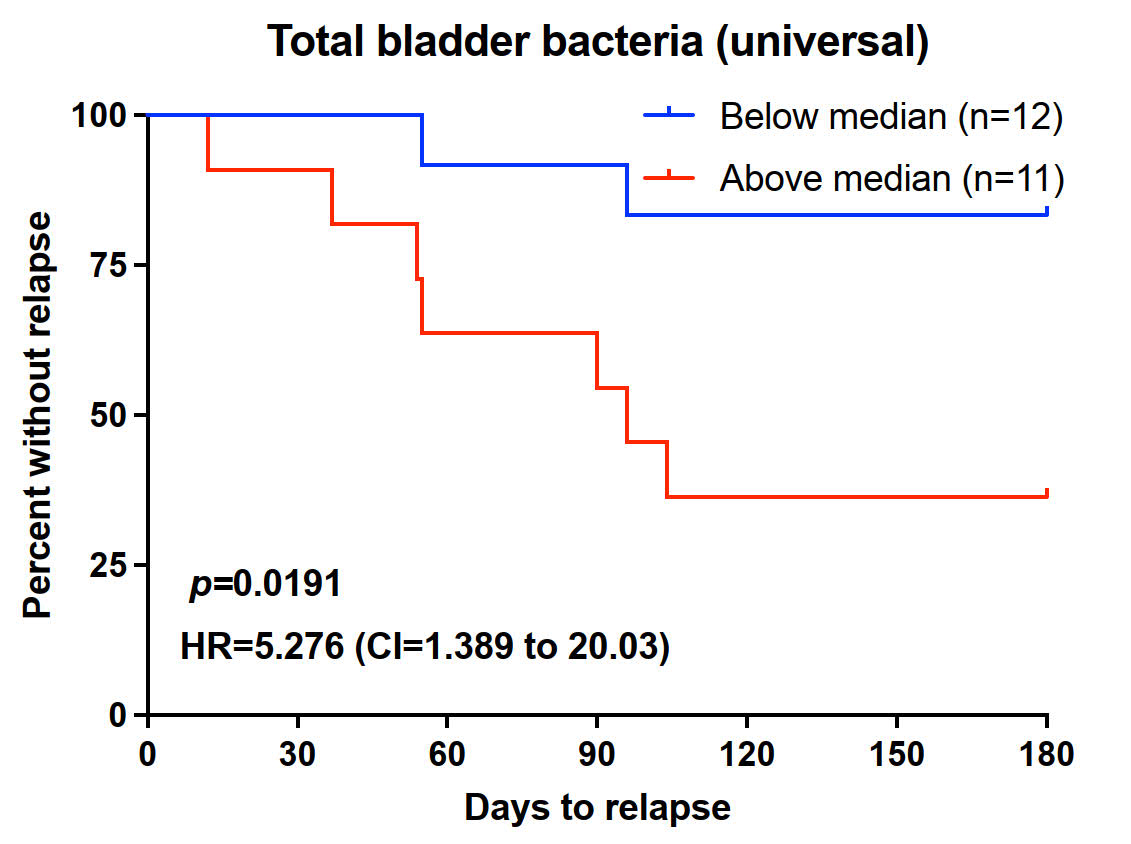
Introduction: Antibiotic-recalcitrant recurrent urinary tract infection (rUTI) is common in postmenopausal women. Therefore, many elect to undergo electrofulguration (EF) of areas of chronic cystitis when standard antibiotic therapies have failed. Previously, tissue-resident bacteria have been observed in the bladder walls of postmenopausal women with rUTI by fluorescence in situ hybridization (FISH). We hypothesized that increased urothelial bacterial burden decreases the likelihood of complete rUTI resolution following EF. Methods: Following IRB approval, bladder biopsies were obtained from 23 consenting postmenopausal women who elected EF for the advanced management of rUTI. Biopsies were processed and 16S rRNA fluorescence in situ hybridization (FISH) was performed as described previously1 using the following probe sets: 1. Scramble-AlexaFluor488/647 (control), 2. Universal 16s rRNA-AlexaFluor647 (all bacteria), and 3. Escherichia 16s rRNA-AlexaFluor488. Images analysis was performed blinded by two separate evaluators to quantify tissue bacterial burden. Time to rUTI relapse after EF was recorded for all patients during a 1-year follow-up period. The group was dichotomized about the median of quantified bladder bacterial burden and Kaplan-Meir analysis was performed to determine if bladder bacterial burden was associated with risk of rUTI relapse. Results: Women with bladder bacterial burden above the median value had a significantly (p=0.0191) higher risk of rUTI relapse within 6 months of EF (HR=5.276, 95% CI: 1.389-20.02) (figure 1). Interestingly, bladder-resident E. coli, as detected by genus-specific FISH, was not significantly associated with a higher risk of rUTI relapse. Conclusions: In this pilot study, we observed that total bladder bacterial burden as quantified by FISH (universal probe) was associated with an ~5.3x increased risk of rUTI relapse within 6-months in postmenopausal women following EF. A continued analysis of this relationship between bladder bacterial burden and rUTI outcomes may prove useful in the management of these challenging patients. References De Nisco NJ et al. J Mol Biol. 2019 doi: 10.1016/j.jmb.2019.04.008 SOURCE OF Funding: N/A