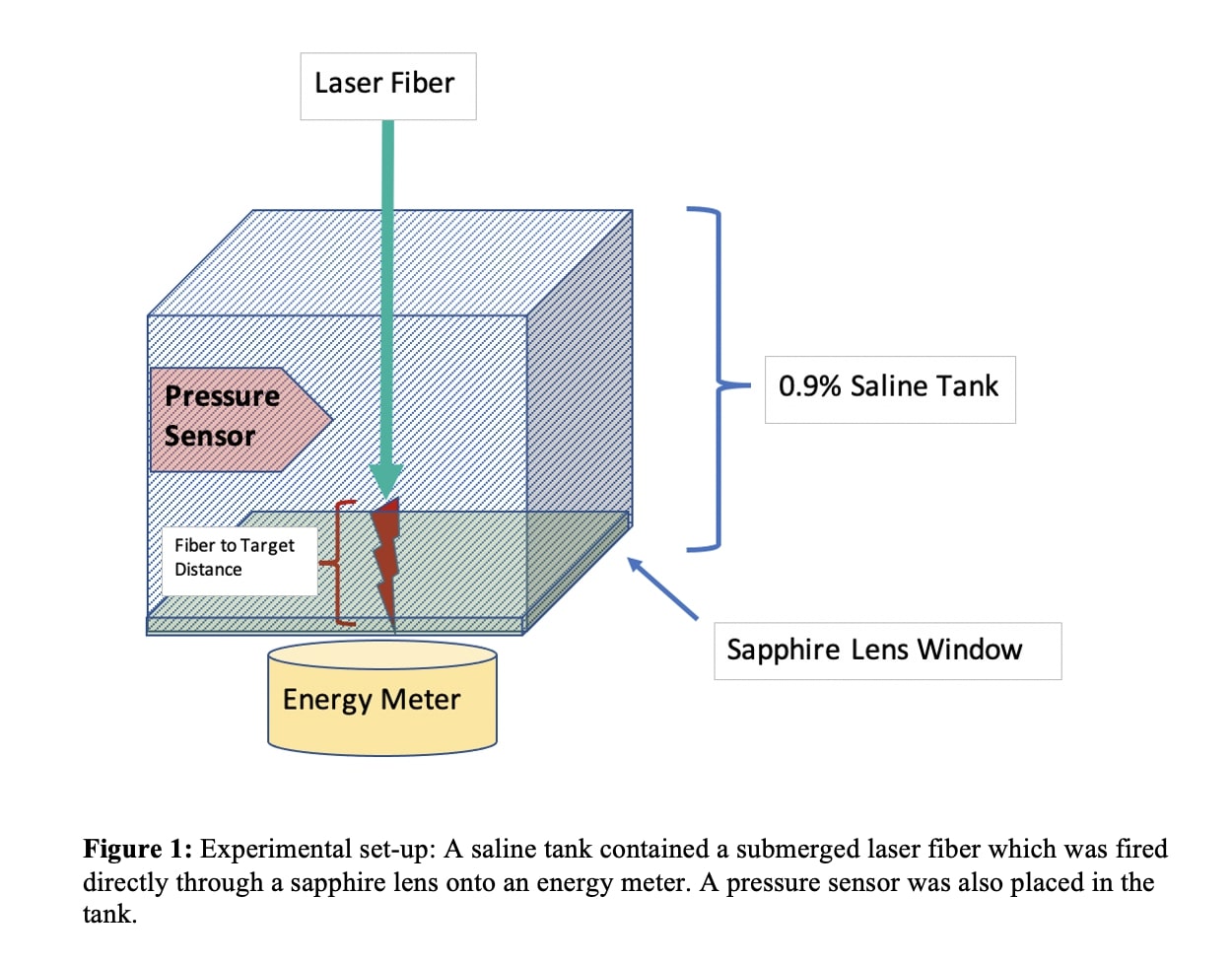
Introduction: To date, the standard for laser lithotripsy has been the Holmium (Ho:YAG) laser; recently a second laser for lithotripsy, the Super-Pulse Thulium fiber laser (sTFL), has become available. To better understand the capabilities of these two competing lasers relating to lithotripsy procedures, we compared the percent energy transmission (PET) of the sTFL and Ho:YAG lasers when aimed at an energy meter, using an array of fiber diameters, energy settings, and target distances. Methods: We compared the PET and pressure produced by the sTFL and Ho:YAG lasers at three settings (popcorn (0.5 J and 40 Hz), dusting (0.3 J and 60 Hz) and fragmentation (1.0 J and 10 Hz)), four fiber sizes (272 µm, 365 µm, 550 µm, and 940 µm), and two distances (1 mm and 2 mm). PET was calculated by normalizing the energy reading when the fiber was fired with and without an interposed sapphire window in a water tank; pressure was recorded with a pressure sensing probe placed in the water tank (Figure 1). The average PET for each condition was compared using a 2-tailed, unpaired t-test. Results: At the 1mm distance, the sTFL had a greater PET than Ho:YAG for popcorn with 550 µm and 940 µm fiber sizes (p-values < 0.01), for dusting with 365 µm, 550 µm, and 940 µm (p-values < 0.01), and for fragmentation with 940 µm (p-values < 0.01). At 1mm, the Ho:YAG had a greater PET than the sTFL for popcorn with 272 µm (p-value < 0.01), and for fragmentation with 272 µm, 365 µm, and 940 µm (p-values < 0.01). At 2 mm, the sTFL had a greater PET for every fiber size at all three energy settings. In all tests, the sTFL yielded lower pressure spikes (Table 1). Conclusions: At 1 mm, sTFL transmits more energy through the 940 µm fiber in all three settings: popcorn, dusting, and fragmentation, and Ho:YAG transmits more energy through the 272 µm fiber in the popcorn and fragmentation settings. At 2 mm, the sTFL has greater energy transmission in all conditions evaluated. The sTFL also resulted in lower pressure spikes than the Ho:YAG across all fiber sizes and laser settings. SOURCE OF Funding: None.