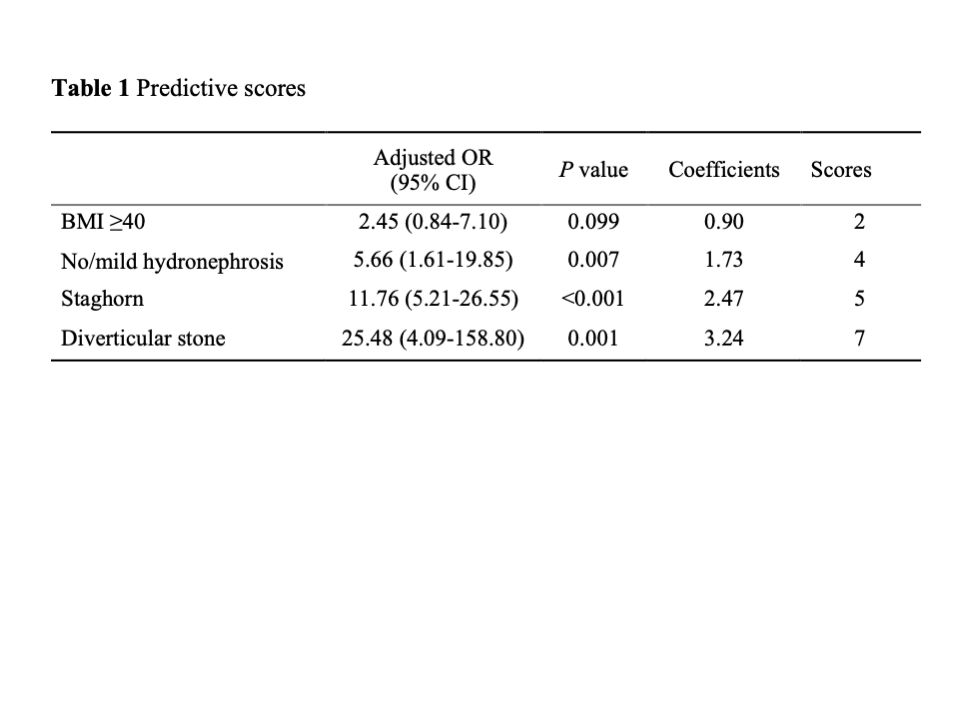
Introduction: Renal access remains a challenging but important step in successful percutaneous nephrolithotomy (PCNL). Understanding factors that predict successful access will help operative planning. With ultrasound guidance for renal access being adopted for widespread clinical practice, this study aimed to develop and validate a novel preoperative scoring system for predicting renal access difficulty for ultrasound-guided PCNL. Methods: We analyzed consecutive patients undergoing ultrasound-guided PCNL from the Registry for Stones of the Kidney and Ureter (ReSKU) between 2015 and 2022. A risk model was created using a randomized data-splitting approach, using 70% for model development and 30% for model validation. Ultrasound-guided access failure was defined as the inability to puncture the renal calyx of choice using ultrasound-only guidance. To create a multivariate model, the preoperative variables were determined using forward selection and modified according to clinical judgment. The predictive scores were created by weighting the coefficients of each significant factor. The total scores were classified into three risk groups according to the prevalence and the correlation of difficult renal access. The final model was validated. Results: Three hundred renal units were used for model development and 90 for validation. Four significant factors were identified in the final model and scored: body mass index = 40 kg/m2 (2 points), no/mild hydronephrosis (4 points), staghorn (5 points), and diverticular stone (7 points) (Table 1). The total scores were categorized into low (0-4 points), moderate (5-8 points), and high difficulty (9-18 points), with a failure rate of 4.1%, 15.4%, and 50% in each group, respectively. This scoring system had a sensitivity of 78.1% and specificity of 80.7% in predicting failures over the moderate difficulty cut-point. The area under the receiver-operating characteristic (ROC) curve in the final model and the validation group were 85.5% and 87.7%, respectively. Conclusions: Our novel scoring system may be an effective screening tool to identify difficult cases for ultrasound-guided access. In these patients, we suggest having backup imaging modalities available for alternate means of achieving access. SOURCE OF Funding: None