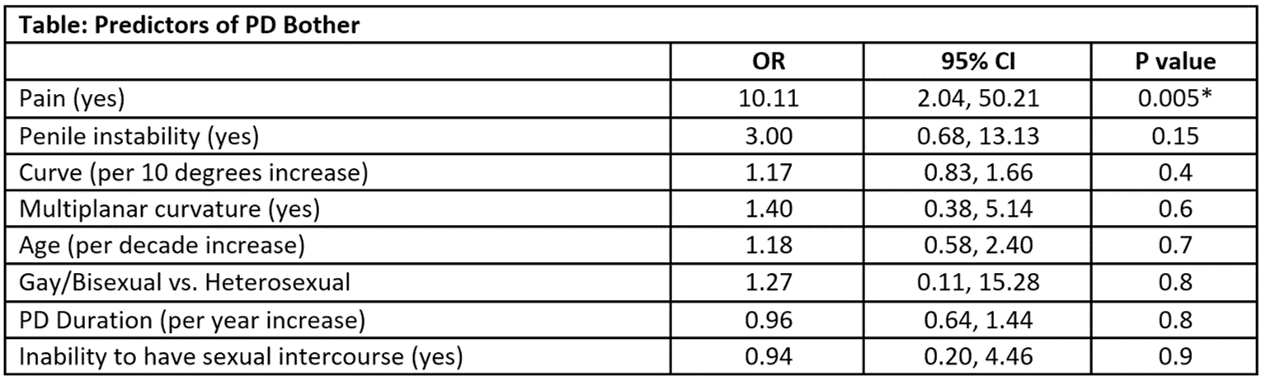
Introduction: There is an association between Peyronie's disease (PD) and psychological bother, depression and relationship dissatisfaction. We aimed to describe the prevalence of these psychosocial issues using validated instruments. Methods: On presentation, all patients with PD who responded to 3 validated questionnaires were included in this study. The inventories included: the Peyronie’s Disease Questionnaire (PDQ), the Center for Epidemiologic Studies Depression Scale (CES-D), and the Self-Esteem and Relationship (SEAR) questionnaire. The PDQ has 3 subdomains, psychological and physical symptoms, penile pain, and bother signs. With worsening negative impact, PDQ scores are higher; a bother domain score =9 indicates clinically meaningful bother. A CES-D score, =16/60 suggests clinical depression. The SEAR contains 14 questions, divided into the domains of sexual relationship and confidence (self-esteem; overall relationship), with a normalized score of 0-100, (higher scores better QOL). Demographics and PD characteristics are reported. We evaluated potential predictors of psychological bother. Parameters included in univariable (UVA) and multivariable (MVA) analysis models: age, sexual orientation, PD duration, multiplanar curvature, pain, intercourse, curvature, penile instability. Results: 720 patients were analyzed. Median age 58 [52, 64] years, 20% had =2 comorbidities, 7% were current smokers. Median PD duration was 10 [4, 24] months, 28% multiplanar curvature, median degree of the primary was 32° [21, 46]. Curvature location: mid-shaft 64%, distal 25%, proximal 11%. 49% had dorsal, 37% lateral, and 14% ventral curvature. Median PDQ scores: psychological and physical (0-24) was 9 [4, 14]; pain (0-30) was 3 [0, 8]; bother (0-16) was 4 [3, 6]; 5% had clinically significant bother. Median CES-D scores 8 [3, 15], 23% had scores =16, indicating clinical depression. Median SEAR scores: sexual relationship 28 [16, 41]; confidence 32 [23, 41]. On UVA, pain (OR: 4.67; 95% CI: 1.4, 14.8; P: 0.009) curvature magnitude (OR: 1.47; 95% CI: 1.1,1.9; P: 0.007) were predictors of bother. Median PDQ pain scores in bothered patients was 14.5 [8.5, 21.2], vs 2 [0, 7] in non-bothered. On MVA (Table), pain was the only predictor of bother. Conclusions: Pain and curvature is associated with bother, and 1 in 4 PD patients have clinical depression. SOURCE OF Funding: SMSNA

.jpg "Luis Novaes, MD photo")