Session: PD18: Infertility: Epidemiology & Evaluation II
PD18-01: A Machine Learning-derived Nomogram to predict pregnancy in Infertile couples with male factor infertility undergoing medically assisted reproduction techniques
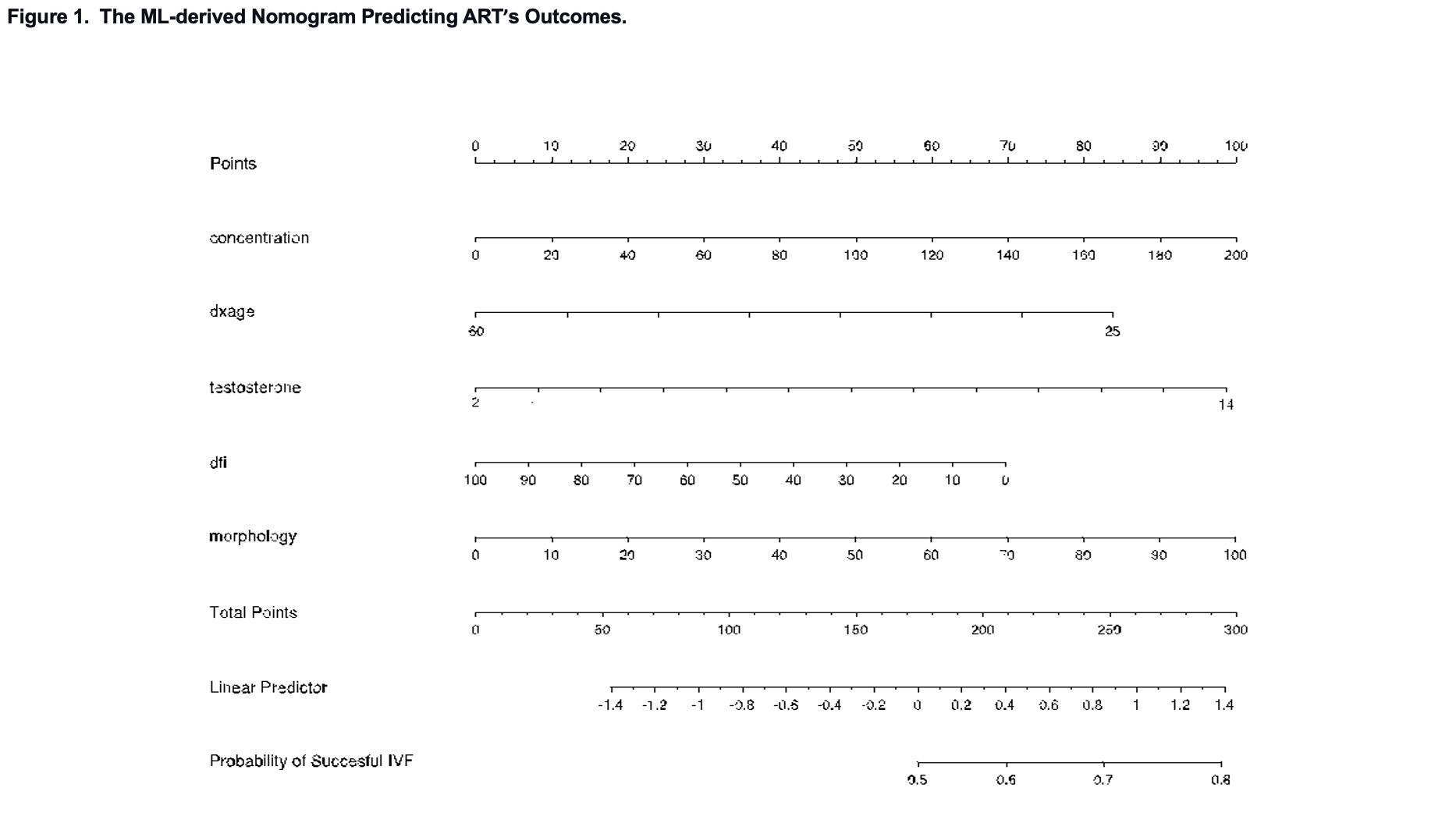
Introduction: It is challenging to predict the probability of a successful assisted reproduction (ART) cycle with adequate accuracy. We sought to develop a predictive nomogram applying Machine Learning to predict the probability of pregnancy in couples with male infertility undergoing ART Methods: Data from 442 primary infertile couples with pure male factor infertility evaluated at a single academic center from April 2004 to May 2018 and submitted to at least one cycle of ART were included in this study. Male patients were randomly subdivided into a training set (70% of all patients) and a test set (the remaining 30%). Using the training set, fourteen variables were selected for the prediction models: patient’s age, BMI, CCI, sex hormonal levels (i.e., FSH, LH, prolactin, tT), semen parameters (i.e., volume, concentration, total motility, morphology, and sperm DNA fragmentation [SDF]), smoking and alcohol intake. A Random Survival Forest-based classifier was built to predict ART outcomes. The mean decrease in accuracy - defined as the decrease in model accuracy from permuting the values in each variable - was used as a variable importance score. tHUS, A nomogram was developed to predict pregnancy based on a multivariable Cox regression model including the 5ìfive most relevant variables. The Harrel's concordance index (c-index) was used to evaluate the accuracy of ML prediction model and the final nomogram Results: Overall, 97 (22%) patients had a successful ART cycle. Median (IQR) age, number of cycles, and time-to-the-last-cycle were 38 (34-41) years, 1 (1-2) cycles, and 1.3 (0.7-2.3), respectively. The ML model’s c-index was 83%. The five most relevant variables selected by the ML model to predict pregnancy were: patients’ age, tT, sperm concentration, sperm morphology, and SDF. Fig. 1 depicts the nomogram derived from the cox-regression model using the five relevant variables. The nomogram’s c-index was 71%. Conclusions: We developed a novel nomogram based on user-friendly infertile men’s clinical parameters to predict ART outcomes by applying a ML algorithm. This nomogram might be useful in patients counselling before ART cycle in the everyday clinical practice. SOURCE OF Funding: None