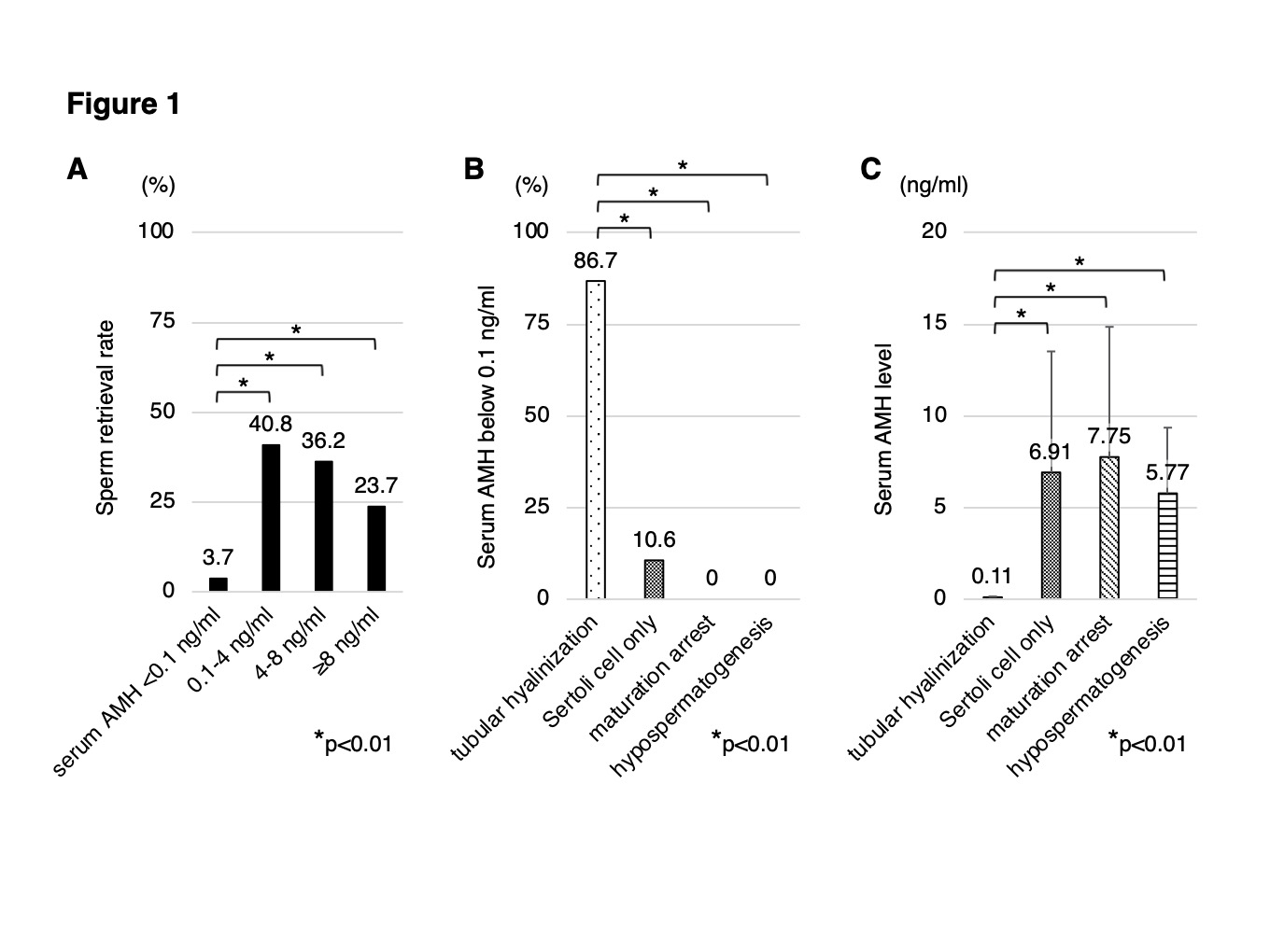
Introduction: Anti-Müllerian hormone (AMH) is secreted by Sertoli cells. Although AMH has been suggested as a marker of spermatogenesis, the relationship between serum AMH and spermatogenesis in non-obstructive azoospermia (NOA) is unclear. Therefore, we investigated the relationship between serum AMH and sperm retrieval rate (SRR), testicular histopathology in NOA. Methods: The study population consisted of 237 patients with NOA who underwent microdissection testicular sperm extraction and had their serum AMH levels measured between January 2015 and December 2021. NOA patients were classified into serum AMH levels <0.1 (detection limit, n=27), 0.1-4 (n=76), 4-8 (n=58) and =8 ng/ml (n=76), and SRRs were compared. In addition, NOA patients were classified into TH (tubular hyalinization, n=15), SCO (Sertoli cell only syndrome, n=132), MA (maturation arrest, n=57) and HS (hypospermatogenesis, n=33) groups. The percentage of patients with serum AMH levels <0.1 ng/ml and serum AMH levels were compared. Results: SRR were 3.7%, 40.8%, 36.2% and 23.7% for serum AMH levels <0.1, 0.1-4, 4-8 and =8 ng/ml, respectively (Figure 1A), with a significant difference between serum AMH levels <0.1 ng/ml and the other groups (p < 0.01). The percentages of patients with serum AMH levels below 0.1 ng/ml were 86.7%, 10.6%, 0% and 0% in TH, SCO, MA and HS groups, respectively (Figure 1B), with a significant difference between TH and the other groups (p < 0.01). Serum AMH levels were 0.11±0.04, 6.91±6.59, 7.75±7.09 and 5.77±3.58 ng/ml for the four groups, respectively (Figure 1C), with a significant difference between TH and the other groups (p < 0.01). Conclusions: When the serum AMH value =0.1 ng/ml, the higher the serum AMH value, the lower the SRR. On the other hand, serum AMH levels <0.1 ng/ml may suggest hyalinization of seminiferous tubules, loss of Sertoli cells and low possibility of sperm retrieval. SOURCE OF Funding: None