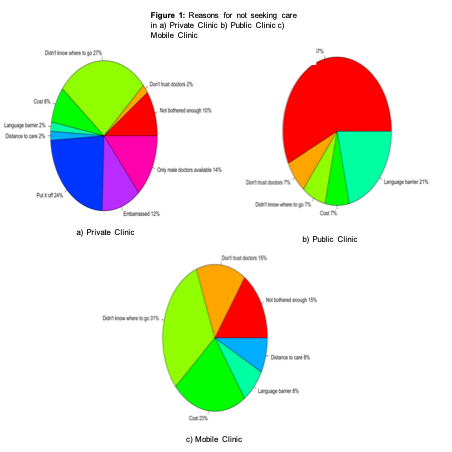
Introduction: Pelvic floor disorders (PFD) affect 25-45% of women, of which only 11% seek surgical intervention despite a wide range of treatments. Trends in care-seeking behaviors vary by race, with minorities less likely to pursue care even when controlling for socioeconomic variables. Our study aims to investigate treatment awareness, treatment-seeking behavior and healthcare access among minority women reporting PFD. Methods: This is an ongoing IRB-approved prospective study, with data collected via a questionnaire comprising the Urinary Distress Index-6 (UDI), Pelvic Organ Prolapse Distress Inventory-6 (POPDI), Female Genitourinary Pain Index (GUPI), and questions on PFD treatments and healthcare access. Recruitment occurred in our private Urogynecology clinic (UG), public safety net hospital Urology clinic (SNH), and community outreach mobile clinic (MC). Treatment awareness, care utilization, and reasons for seeking medical interventions were investigated. Analysis was conducted using R (Version 4.1.1), with disease severity defined by > 33.3 (UDI) and > 3rd quartile (POPDI, GUPI). Results: 107 participants were recruited. Median age was 53 years [IQR 24]. 53 (49.5%) women were Hispanic, 38 (35.5%) were Black, and 16 (15%) identified as Other. Of the 80 (74.8%) patients with reported PFD, 26 (32.5%) were not aware of available treatments while only 33 (41.3%) reported receiving treatment. UG (p = 0.02) and SNH (p = 0.03) participants were 1.4 times more likely to seek care compared to MC participants. There was no statistically significant difference between race and treatment seeking rates. Reasons for not seeking care based on clinic setting are shown in Figure 1. UG and MC participants most commonly cited “not knowing where to go” (27% and 31%, respectively), while SNH cited not being bothered enough (57%). Conclusions: Among minority participants with PFD in this cohort, one-third were unaware of treatment options and less than half received treatment. The most reported reason for not seeking care was not knowing where to go, with the community outreach population having the lowest rate of obtaining care. Awareness of treatment options and where to access care is a major barrier among minority women with PFD and highlights the need to improve treatment awareness and access. SOURCE OF Funding: Urology Care Foundation Award '21