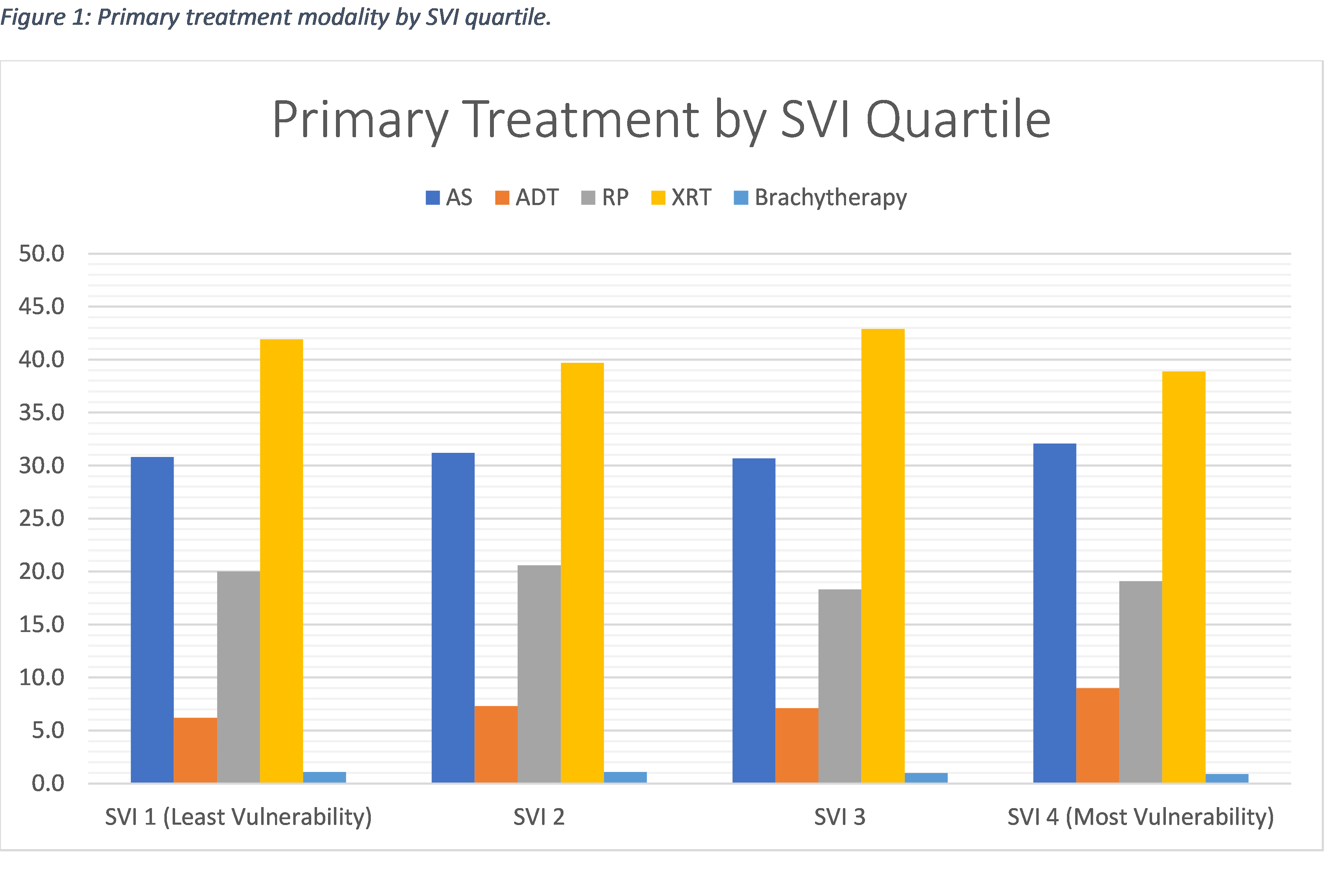
Introduction: Individual characteristics such as race, ethnicity, and socioeconomic status (SES) are well-established risk factors for poor outcomes across the care continuum in various cancers, including prostate cancer. However, these metrics may not capture the complexity of social determinants of health (SDOH) and systemic barriers that often underlie suboptimal care. We evaluate the association of community-level SDOH as measured by the Centers for Disease Control and Prevention’s Social Vulnerability Index (SVI) with diagnostic and treatment patterns in patients with newly diagnosed prostate cancer (PCa). Methods: We used Medicare claims data to perform a retrospective cohort study of men >65 years with newly diagnosed PCa between 2015-2019. SVI was abstracted and linked to each beneficiary at the county-level and categorized into quartiles (i.e., least vulnerable to most vulnerable). Patient demographics, SES measures, diagnostic and treatment modalities were compared across SVI quartiles. Group comparisons were tested with chi-squared analyses. Results: We identified 138,207 men with newly diagnosed PCa. A greater proportion of men residing in the most vulnerable counties were older, of minority status, more comorbid, living in rural locations with lower SES, and more often dual-eligible (all p<0.001). In terms of diagnosis, these men were less likely to undergo prostate MRI prior to or after diagnosis, but more likely to have a bone scan after diagnosis (all p<0.001). In terms of treatment, these men were less likely to be managed with active treatment (prostatectomy or radiation therapy), and more likely to be managed with primary ADT or active surveillance (all p<0.001). Conclusions: In a large cohort of Medicare beneficiaries with newly diagnosed PCa, men residing in higher SVI counties were more disadvantaged, less likely to undergo appropriate diagnostic testing, and less likely to be managed with definitive local therapy. Measuring, understanding, and mitigating SDOH is necessary to provide equitable cancer care for patients with PCa. SOURCE OF Funding: Prostate Cancer Foundation