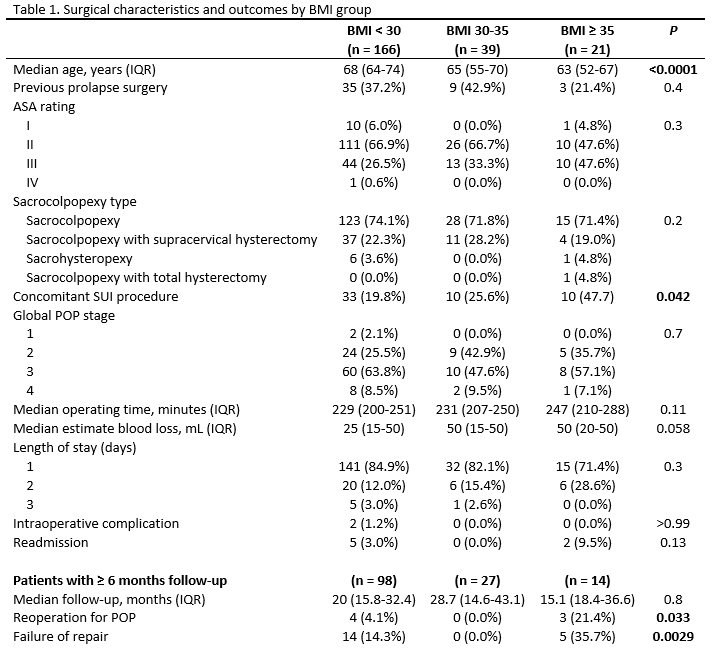
Introduction: Obesity is a known risk factor for pelvic organ prolapse (POP) and its prevalence has been increasing worldwide. Many obese women with POP seek treatment, and robotic sacrocolpopexy (RSC) is a gold standard for apical POP. We sought to investigate the impact of obesity on complication rates and clinical outcomes in women undergoing RSC at our institution. Methods: IRB approval was obtained for this study. We reviewed the charts of all women who underwent RSC at our institution between December 2013 and September 2022 and compared women without obesity, those with class 1 obesity (BMI =30 and <35), and those with class 2 obesity or greater (BMI =35). Patient characteristics included age, ASA score, and surgery performed. Outcomes assessed included operating time, estimated blood loss (EBL), length of stay (LOS), intra-operative complications, and readmission rates. Additional clinical characteristics evaluated included history of prolapse surgery, pre-operative POP-Q stage, and follow up time. Outcomes evaluated were POP recurrence beyond the hymen, sensation of bulge, further surgery for POP, and overall failure rate (composite of the last three outcomes mentioned). Results: 166 non-obese and 60 obese women were included in our study. 39 patients had BMI =30 and <35; 21 had BMI =35. Obese patients were significantly younger than non-obese patients (p <0.0001). Patients with BMI =35 were more likely to undergo a simultaneous SUI procedure (p=0.042). There were no significant differences in ASA score, type of RSC, or likelihood of having a concomitant rectopexy or other major procedure. There were no significant differences in LOS, intra-operative complications, EBL, operating time, or readmission rates between groups. There were no significant differences in length of follow up. Among patients with =6 months of follow up, none experienced recurrence of apical prolapse. Those with BMI =35 were more likely to experience failure in the anterior or posterior compartment (p=0.0029) and need for additional surgery for POP (p=0.033). Conclusions: Obesity was not associated with higher EBL, operating time, intra-operative complications, or readmission rates. However, BMI =35 was associated with higher failure rates and need for further surgery for POP. SOURCE OF Funding: Internal funding