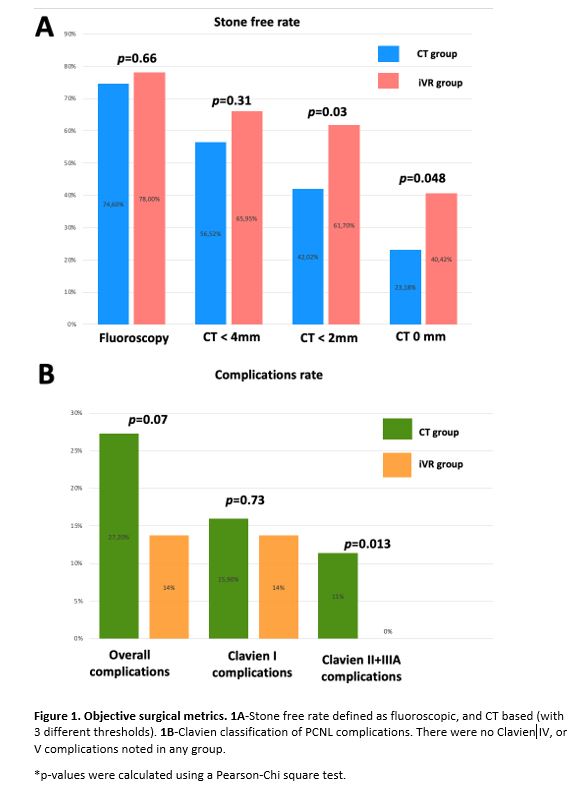
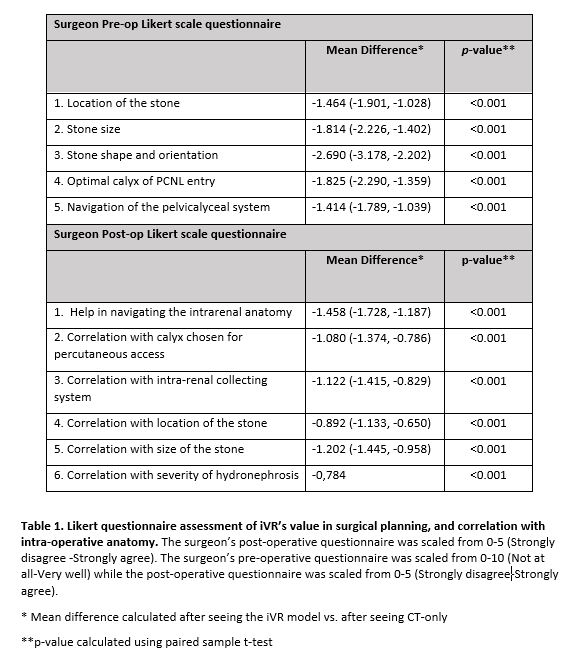
Introduction: Understanding the size of a renal stone, its location and relationship with the collecting system is crucial for a successful percutaneous nephrolithotomy (PCNL). Our objective was to study the impact of preoperative immersive virtual reality (iVR) on surgical planning and outcome. Methods: Between 2019 and 2022, 125 PCNL patients were randomized into either a CT only group (n=75) or an iVR group (n=50). Pre-operatively, using 3D Slicer software, CT scans were rendered into iVR simulations that allowed the surgeon to visualize and manipulate the relevant anatomical landmarks and to simulate the percutaneous approach to the proposed calyx of entry and the renal stone. Surgeon understanding of the case anatomy after viewing the CT scan and after the iVR experience were compared using a Likert scale questionnaire. Postoperative CT scans using 2-3mm cuts were defined as stone free (i.e., no stones), <2mm remnants, or <4 mm remnants. Postoperative complications were defined using the Clavien classification. Results: There was a significant increase in stone free and <2mm remnant rate in the iVR group: 19.7% and 17.24%, respectively (Figure 1). There was a trend towards an increased volume of stone ablated per minute of surgery (p=0.07). Of note, 28% of surgeons changed their calyx of choice for PCNL after viewing the iVR model. In the iVR group, there was a 11% lower rate of postoperative complications (Clavien II-III, p=0.013). Surgeons noted that viewing the iVR model enhanced their understanding of the intra-renal anatomy, stone location, stone size, stone shape, orientation of each stone-bearing calyx, and the optimal calyx for renal access (all p<0.01) (Table 1). Conclusions: Preoperative visualization of an iVR CT generated model improved the urologists’ understanding of the renal anatomy, impacted the surgical plan and was associated with a statistically significant higher stone clearance rate and a lower incidence of Clavien II and III complications. SOURCE OF Funding: None.