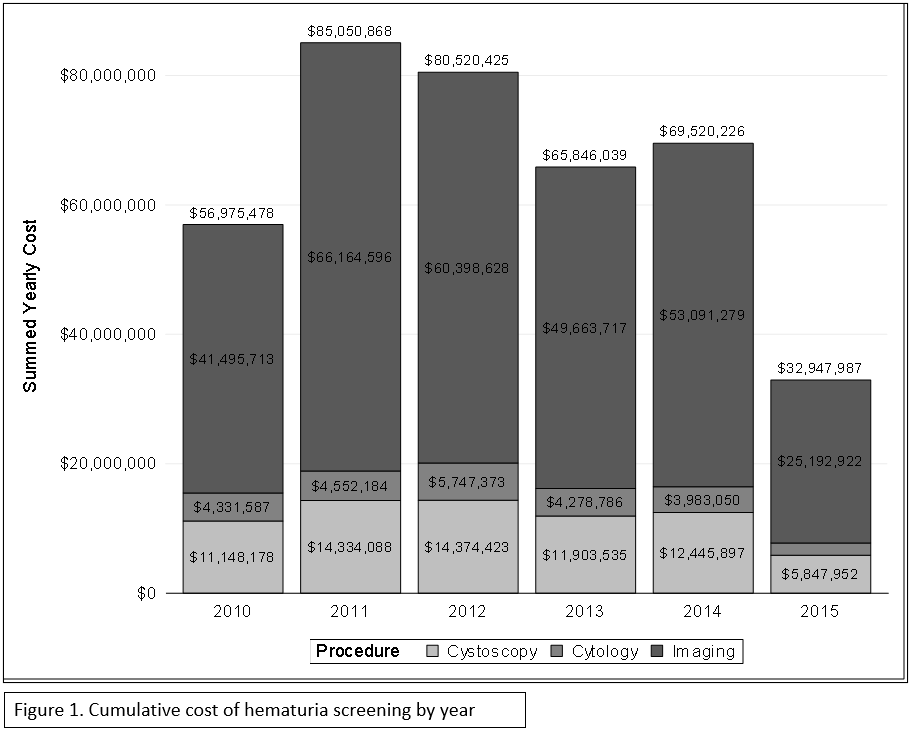
Introduction: The urologic workup following hematuria diagnosis burdens the healthcare system with significant cost. Using a privately-insured, claims-based national cohort, we sought to evaluate the cost of hematuria evaluation. We hypothesized that evaluation with contrast-enhanced computed tomography (CT) confers more cost to hematuria evaluation than renal ultrasound (US). Methods: Using a national, privately insured database (MarketScan), we identified all individuals with an incident diagnosis of hematuria. We included patients who underwent cystoscopy and upper tract imaging within 3 months of diagnosis. We tabulated the costs of the imaging study as well as the total healthcare cost per patient. A multivariable model was developed to evaluate patient risk factors associated with total healthcare costs. Results: We identified 377,359 patients with hematuria who underwent evaluation. Median costs associated with upper tract imaging were $425 overall, $359 for CT with contrast, $117 for US, $622 for MRI, and $226-253 for other imaging (CT without contrast, retrograde pyelogram). Median cystoscopy cost was $294. Total healthcare costs per patient were highest amongst patients undergoing MRI and CT imaging. When adjusted for comorbidities, tobacco use, higher Elixhauser index, gross hematuria and male sex were associated with higher costs of hematuria evaluation. Based upon previously presented rates of upper tract findings, we found a total cost per upper tract lesion to be $19,300 for US, $34,352 for CT, and $25,000 overall. Annual spending on imaging was 4- to 5-fold spending on cystoscopy (Figure 1). Conclusions: Hematuria evaluation confers a significant cost burden to the healthcare system, primarily driven by upper tract imaging. Patients with hematuria risk factors were associated with higher total healthcare costs of screening. Increased adoption of US-based imaging strategies may lead to higher value care. SOURCE OF Funding: None