The Smith Institute for Urology at Hofstra/Northwell
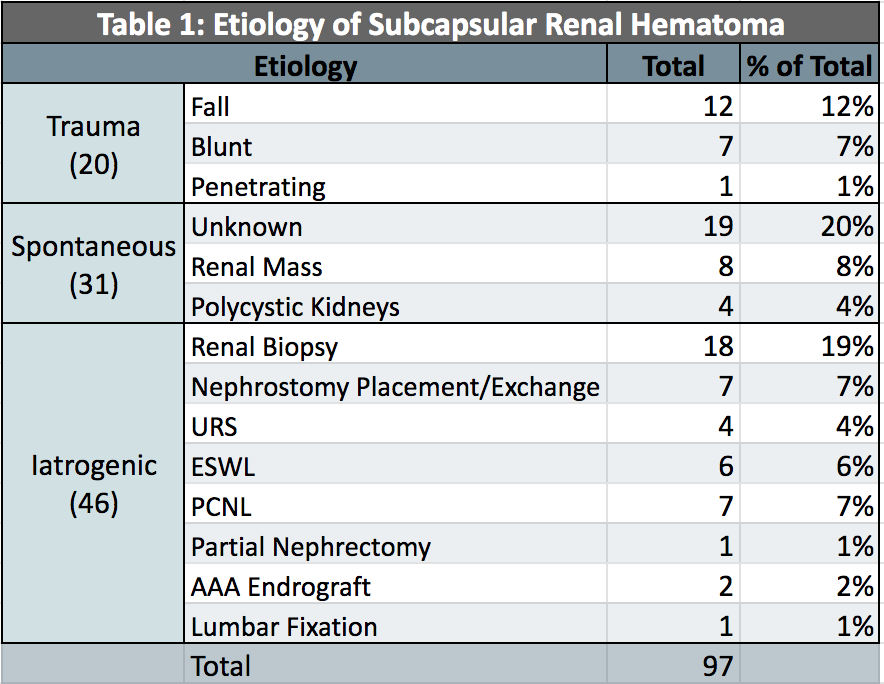
Introduction: The subcapsular renal hematoma (SRH) is a rare radiologic finding, but one with significant potential risks in the acute and chronic settings. The urologic community needs to better understand the clinical course of SRH in order to anticipate the severity of possible complications during management. Methods: A natural language processing search algorithm in Nuance mPower Clinical Analytics screened CT and MRI studies for “renal hematomas” across nine Northwell Health hospitals, including a Level 1 Trauma Center from 2011 to 2021. Patients with at least 3 cross-sectional exams to track progression and time to resolution were included. Retrospective chart review assessed etiology of hematoma, interventions and management of clinical sequelae. Results: We included 97 patients with acute diagnosis of SRH in the native kidney. Etiologies included traumatic (21%), spontaneous (32%), and iatrogenic causes (47%), as seen in Table 1. Three patients developed Page kidney with hypertension secondary to renin-angiotensin-aldosterone system activation, two of which had solitary kidneys, each requiring new hemodialysis or operative hematoma evacuation. The Page kidney with a contralateral functional kidney was managed conservatively. Six patients developed infected perinephric hematomas, five requiring drainage by interventional radiology (IR) and one requiring nephrectomy, on day 85, on average. 21 patients had perinephric bleeding requiring IR angiography, 17 of which underwent renal artery embolization. One patient had intractable pain, requiring operative hematoma evacuation on day 34. Another patient developed abdominal compartment syndrome requiring decompressive laparotomy. 94 patients had repeat imaging within ten months, and 20 (21%) demonstrated hematoma resolution. 18 patients had imaging between 10 and 15 months, of which 8 (44%) had resolved. The average time to resolution was 368 days. Conclusions: Subcapsular hematoma is a rare finding, most commonly after renal biopsy. 35% of patients required intervention including hemodialysis, embolization and nephrectomy. One third of spontaneous SRH required embolization, most commonly those with underlying renal masses. Page kidney phenomenon is rare (3%), but possibly more likely in solitary kidney. SOURCE OF Funding: None