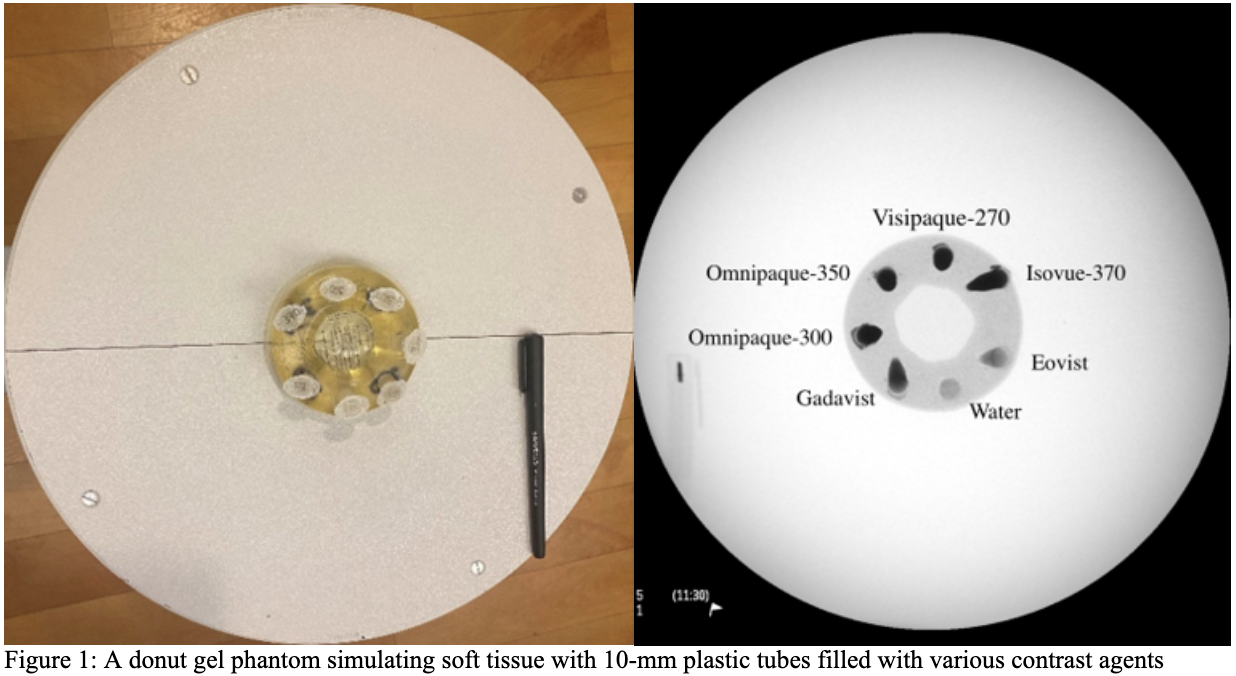
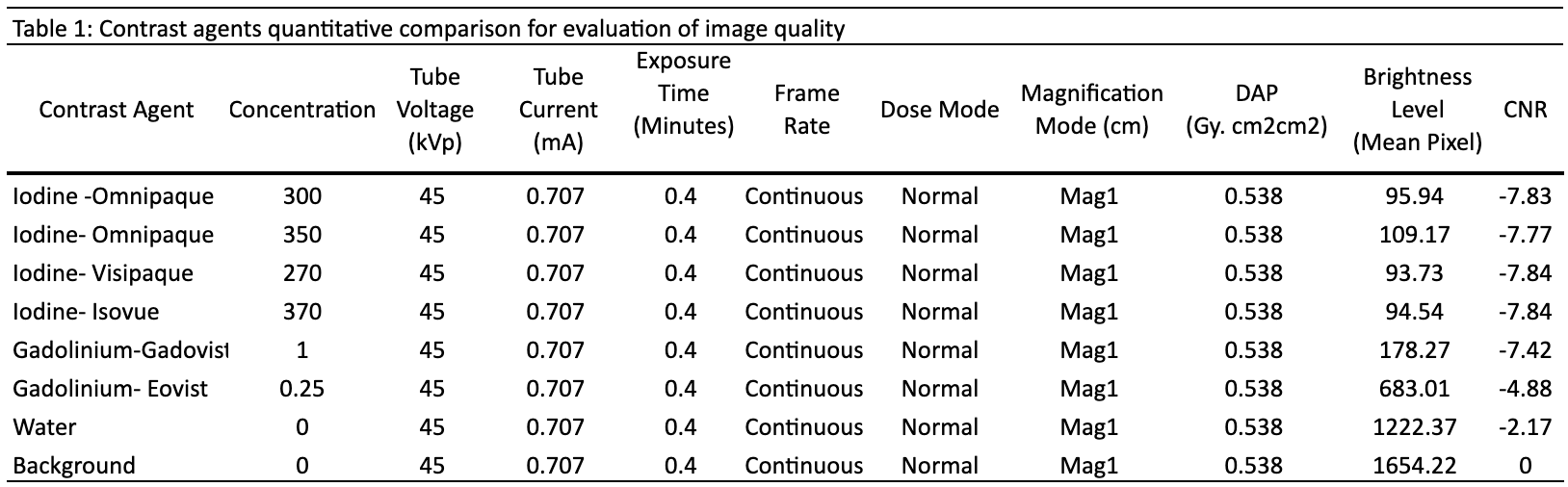
Introduction: The recent international shortage of iodinated contrast agents has driven many clinicians to search for alternative agents to image a variety of urologic conditions in order to maintain clinic workflow. We sought to standardize these agents by a quantitative comparison using a phantom model. Methods: A donut shape gel phantom with 10-mm wide plastic rods filled with Omnipaque-300, Omnipaque-350, Visipaque-270, Isovue-370, Gadavist, Eovist, and liquid water, was used to represent a patient being imaged for an urethrogram study utilizing a mobile fluoroscopy. The phantom was imaged with various acquisitions (Auto tube voltage (kVp), tube current (mA), and various dose modes, frame rates, and magnification modes) to compare and asses image quality for different contrast agents. Quantitative evaluations were performed with extracting regions of interest (ROIs) of each contrast rod to gather mean pixel values and standard deviations. These ROI measurements were then utilized to calculate contrast-to-noise ratio (CNR) as the metric appropriate for image quality evaluation. Results: The mean pixel and CNR values of Omnipaque-300, Omnipaque-350, Visipaque-270, Isovue-370, and Gadavist showed no difference in visibility among these five contrast agents while using different dose modes, frame rates, and magnification modes. However, that was not the case for Eovist as its mean pixel value and CNR value were close to those of liquid water. Furthermore, changing magnification from normal to magnification 1 and magnification 2 increased the mean pixel values and CNR values at normal dose and continuous frame rate. Conclusions: With the exception of Eovist, the iodinated and gadolinium-based contrast agents we tested can be interchanged without compromising visibility or image quality based upon this comparative phantom study. SOURCE OF Funding: None