Session: MP11: Prostate Cancer: Advanced (including Drug Therapy) I
MP11-04: Androgen-deprivation therapy and the risk of newly developed neovascular age-related macular degeneration in patients with prostate cancer: a nested case-control study
Departments of Urology, Gangnam Severance Hospital, Urological Science Institute, Yonsei University College of Medicine
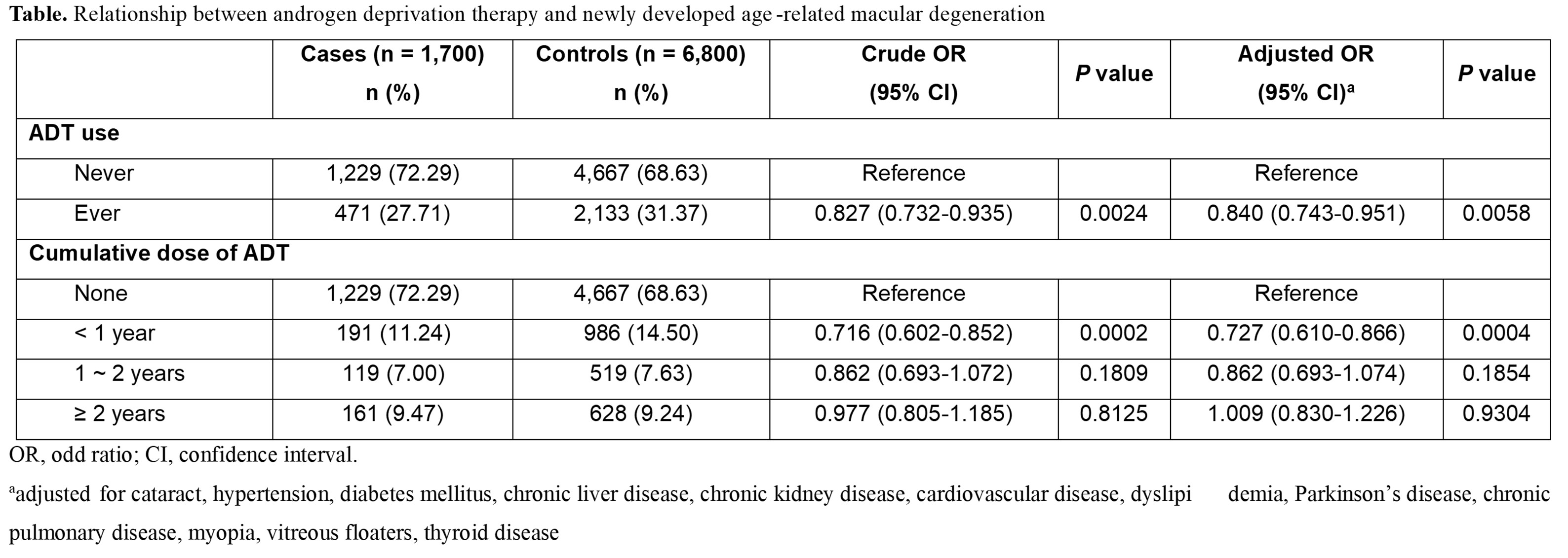
Introduction: We evaluated the association between newly developed neovascular age-related macular degeneration (AMD) and androgen deprivation therapy (ADT) in patients with prostate cancer. Methods: A nested case-control study was performed. From the nationwide claims database in the Republic of Korea, 228,803 men with prostate cancer were identified between August 1, 2009 and December 31, 2018, and followed through April 2021. After applying the exclusion criteria, 193,090 patients were included in the final analysis. Cases were defined as those who were newly diagnosed neovascular AMD during follow-up and 1,751 patients were identified. Cases were matched with controls based on age, index date, and duration of follow-up with a a case to control ratio of 1:4 cases. Adjusted odd ratios (aORs) of incident neovascular AMD associated with ADT use were estimated using conditional logistic regression. Results: The main analysis included 1,700 cases and 6,800 controls with a median follow-up of 3.42 years. The use of ADT was associated with a reduced risk of incident neovascular AMD in patients with prostate cancer compared with that of non-ADT users (aOR = 0.840; 95% confidence interval [CI], 0.743-0.951; P = 0.0058) in multivariable analysis. An accumulated dose of ADT less than 1 year was associated with a reduced risk of neovascular AMD (aOR = 0.727; 95% CI, 0.610-0.866; P = 0.0004), however, no association was observed in the duration of ADT between 1 and 2 years (aOR = 0.862; 95% CI, 0.693-1.074; P = 0.1854) and more than 2 years (aOR = 1.009; 95% CI, 0.830-1.226; P = 0.9304). Conclusions: In prostate cancer patients, androgen suppression was associated with a reduced risk of incident neovascular AMD. A relatively short duration of ADT of less than 1 year was associated with a reduced risk of incident neovascular AMD, but this association disappeared as the longer duration of ADT. These results suggest that androgen may be involved in the pathogenesis of neovascular AMD. SOURCE OF Funding: This study was supported by the 2021 Research Grant of the Korean Urological Association.