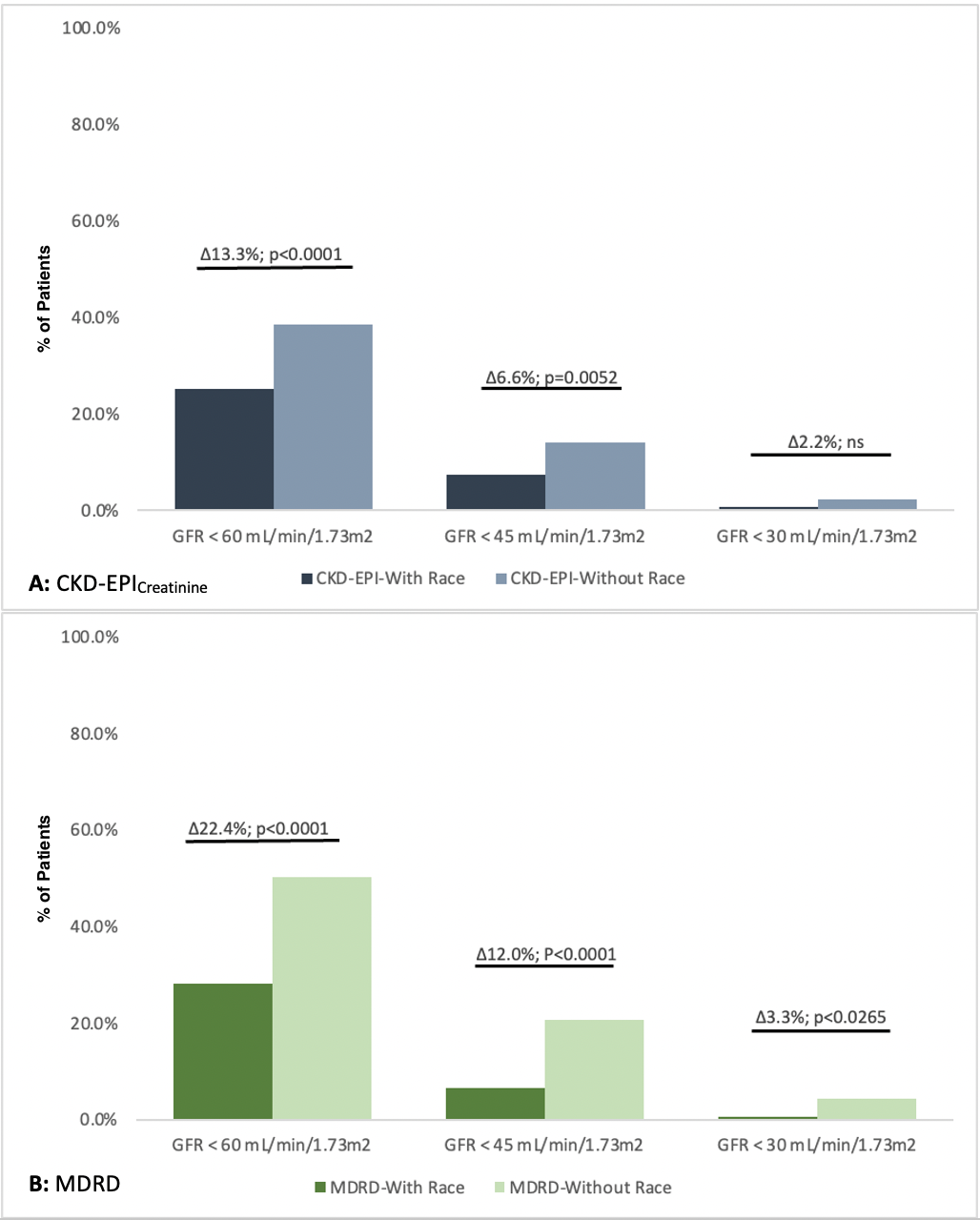
Introduction: Race is no longer recommended in estimated glomerular filtration rate (eGFR) equations. The resulting lower eGFR may positively impact black patients, such as with earlier nephrology referral and renal transplant eligibility. The impact of race-free equations on black patients with renal cell carcinoma (RCC)–a cohort more likely to experience inferior cancer outcomes–has not been fully examined. Renal function assessment is important in patients with RCC given the recommendations of nephron sparing approaches (i.e. partial nephrectomy [PN]) over radical (RN) in patients with CKDIIIa or estimated post-nephrectomy eGFR of <45mL/min/1.73m2. Here, we analyze removal of race from eGFR in black patients with RCC and consider the impact of this change in the context of RCC treatment. Methods: Self-identified black patients undergoing nephrectomy at an academic referral center from 2009-2021 were identified. Patients with end-stage renal disease were excluded. Using preoperative creatinine, height, and weight, eGFR was calculated with the Chronic Kidney Disease Epidemiology Collaboration creatinine equation with and without race (CKD-EPI-WithRace; CKD-EPI-WithoutRace, respectively), and the Modification of Diet in Renal Disease equation with and without race (MDRD-WithRace; MDRD-WithoutRace, respectively). Distribution of patients and changes within CKD stages with different equations was considered. Subgroup analysis was completed on patients with stage III-IV disease only. Results: 459 self-identified black patients that underwent nephrectomy at our institution were identified, 135 of which had stage III-IV disease. eGFR decreased around 10-13ml/min/1.73m2 with removal of the race coefficient. 13-22%, 6-12%, and 2-3% more black patients would fall under common CKD cutoffs of 60, 45, or 30ml/min/1.73m2, respectively, depending on the equation used (Figure 1). Subanalysis of stage III-IV patients only were similar. Conclusions: Race free renal function equations may result in significantly more black patients being encouraged to undergo nephron sparing treatments. SOURCE OF Funding: We gratefully acknowledge the support of the John Robinson Family Foundation and the Chris Churchill Family Foundation.